HFT Stuttgart’s International Master Smart City Solutions (SCS) a programme designed for mid-career professionals in the fields of architecture, urban design, urban planning, infrastructure or engineering; equipping them to take leading roles in complex international projects.
Attracting experienced postgraduates from around the world, the Master Programme provides you with the knowledge and methods to work in smart city projects with a focus on strategy, concept and project implementation: either self-employed, as a leading consultant for an international company or as a leading architect, urban planner or engineer.
Our flexible, modular structure allows students to study full-time or to combine their studies with part-time work in their current job.
Application deadline
Phase 1: November - 28 February
Phase 2: May - 15 July
Start of Studies: Mid-September
(Applicants from outside the EU please observe visa deadlines and apply accordingly.)
A professionally qualifying higher education degree (Bachelor’s, Master’s, Diplom or equivalent)
related to architecture, urban planning, civil engineering, infrastructure, real estate management or other planning-related disciplines within the smart city field. For degrees in other disciplines, the selection committee will assess each case individually.
The degree must comprise at least 210 credit points (CP) under the European Credit Transfer and Accumulation System (ECTS), which corresponds to 7 semesters of full-time study. F
In the case of a first professional degree with a standard duration of 6 semesters or 180 credit points, evidence of additional relevant academic achievements totalling 30 credit points must be provided, or these must be acquired either during the master programme or in a preparatory semester. The selection of suitable modules is made in consultation with the Dean of Studies.
At least one year of relevant professional experience by the start of the programme
English language proficiency, demonstrated by:
TOEFL iBT (internet-based) score of 4.5 or higher (test date after 21 January 2026), TOEFL iBT score of 86 or higher (test date before 21 January 2026)
or: IELTS Academic, score 6.5 or higher
or: for applicants who have obtained their university entrance qualification, or their first or second degree, in one of the following predominantly English-speaking countries: Antigua and Barbuda, Australia, the Bahamas, Barbados, Belize, Canada, Dominica, Grenada, Guyana, Ireland, Jamaica, Malta, New Zealand, Saint Kitts and Nevis, Saint Lucia, Saint Vincent and the Grenadines, Trinidad and Tobago, United Kingdom, United States of America: Statement from the awarding institution
Successful participation in an admission interview. Only applicants who meet the requirements set out in points 1 to 4 may take part in the admission interview.
Application procedure
STEP 1
Prepare application documents
Certificate of the first degree or of the qualifying degree (for foreign qualifications, an English or German translation must also be provided)
Certificate of university entrance qualification/ school leaving ceritificate (for foreign qualifications, an English or German translation must also be provided)
Curriculum vitae in tabular form
Passport photograph
Proof of at least one year’s relevantprofessional experience (signed letter by current employer and/or former employer/s)
Letter of motivation, which should include the following points: reasons for choosing the master programme Smart City Solutions, expectations of the programme, the significance of the programme for future career plans, and thoughts on how participation in the programme will be funded (max. 1 A4 page)
Academic essay on a given smart city topic (600–900 words) (for instructions please refer to the admission essay guideline linked in the download section below)
Proof of English language qualification
TOEFL iBT (internet-based) score of 4.5 or higher (test date after 21 January 2026), TOEFL iBT score of 86 or higher (test date before 21 January 2026)
or: IELTS Academic, score 6.5 or higher
or: for applicants who have obtained their university entrance qualification, or their first or second degree, in one of the following predominantly English-speaking countries: Antigua and Barbuda, Australia, the Bahamas, Barbados, Belize, Canada, Dominica, Grenada, Guyana, Ireland, Jamaica, Malta, New Zealand, Saint Kitts and Nevis, Saint Lucia, Saint Vincent and the Grenadines, Trinidad and Tobago, United Kingdom, United States of America: Statement from the awarding institutio
Portfolio (this document is optional)
STEP 2
Submit documents - Digital submission only
Applications for September 2027 and later must be submitted through the online application portal.
The online application portal opens in the first week of November (till February 28) and re-opens the first week of May (till July 15).
The button “Apply Now!" will appear at the top of this webpage.
Application form filled out electronically via application portal;
Upload all certifictes stated above on the portal
300 dpi resolution for scanned certificates (as above)
English Language Certificate can be submitted after the deadline but no later than 15. July
STEP 3
Selection criteria and selection procedure
In the first stage, an assessment is made as to whether the entry requirements set out in STEP 1 have been met.
In the second stage, an admission interview is conducted by a professor from the master programme using a structured interview questionnaire. The following criteria are assessed on a scale: a. Focus on topics relevant to the master programme b. International orientation c. Ability to communicate in English in a subject-specific professional context d. Willingness to perform and take on responsibility If an applicant can credibly demonstrate that, due to long-term or chronic physical or mental health conditions, they are unable to complete the selection process, in whole or in part, in the prescribed form, the selection committee will permit the process to be carried out in an alternative, equivalent form. A medical certificate may be required for this purpose.
Duration of interview: 30 – 45 minutes
STEP 4
Notification about the decsion of the selection committee.
Submission deadlines
Phase 1: November - 28 February
Phase 2: May - 15 July
Start of Studies: Mid-September
Applicants from outside the EU please observe visa deadlines and apply accordingly.
(If applicants from non-EU countries can demonstrate that, due to visa processing times, it is not possible to commence their studies in the same year as their application, an offer of a place may be made for the next possible start date.)
The Master Programme Smart City Solutions is a so-called Continuing Education Programme. A Continuing Education Programme is a fee-based academic degree programme for which tuition fees are incurred. The following table provides information on tuition fees:
Tuition Fee Full-time
1nd Semester
4.000 €
2nd Semester
4.000 €
3rd Semester
2.000 €
Total
10.000 €
*Students who care for and bring up a child and/or students with a disability are advised to check their eligibility for a tuition fee reduction according to §3 (1) or (2) SCS Fees Statutes.
**Costs for international money transfer and currency exchange must be paid by the student. Payment of the total in a single transfer is possible.
*Students who care for and bring up a child and/or students with a disability are advised to check their eligibility for a tuition fee reduction according to §3 (1) or (2) SCS Fees Statutes.
**Costs for international money transfer and currency exchange must be paid by the student. Payment of the total in a single transfer is possible.
Additional Non-tuition Fees and Expenses (Applicable for All Students)
Compulsory non-tuition fees | approx. 200 € / semester | Listed in the FAQ section "Tuition and Payments" below.
Compulsory field trips | approx. 600 € in total | Travel expenses for overnight and day-trips related to the curriculum.
Accommodation and living expenses | according to lifestyle | See FAQ section below.
Additional Tuition Fees, Non-tuition Fees and Expenses (If Criteria Apply)
Additional semester | 1,000 € | Compulsory for students with Bachelor's Degree between 180 and 210 ECTS, and/or in case of failed or not attended Modules.
Compulsory non-tuition fees for additional semester or for semester with leave of absence | approx. 200 € / semester | Listed in the FAQ section "Tuition and Payments" below.
Visa process (non-EU citizens) | varies | See FAQ section below.
Blocked account (non-EU citizens) | Refundable deposit as proof of financing required by the German immigration authorities. See FAQ section below.
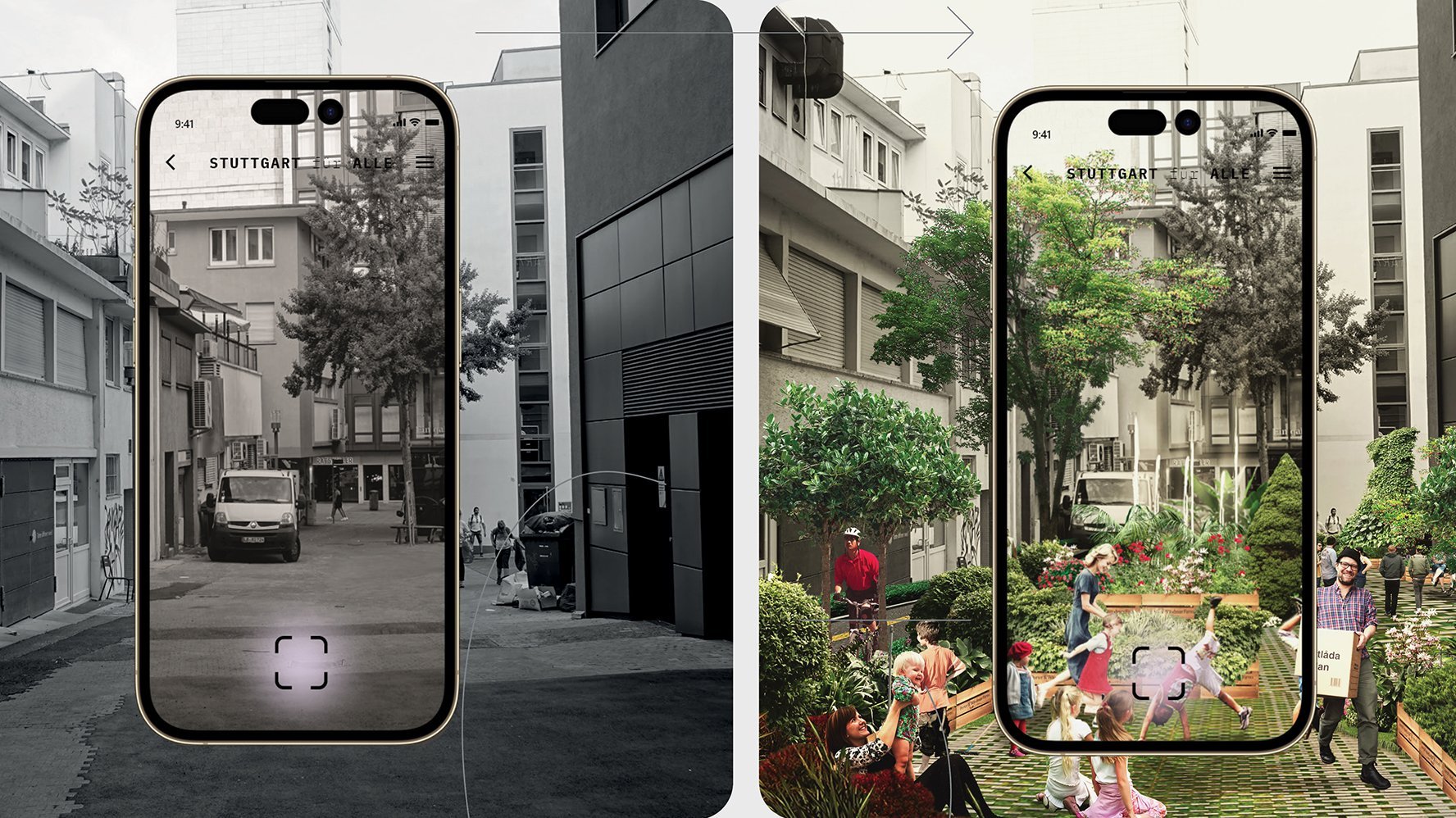
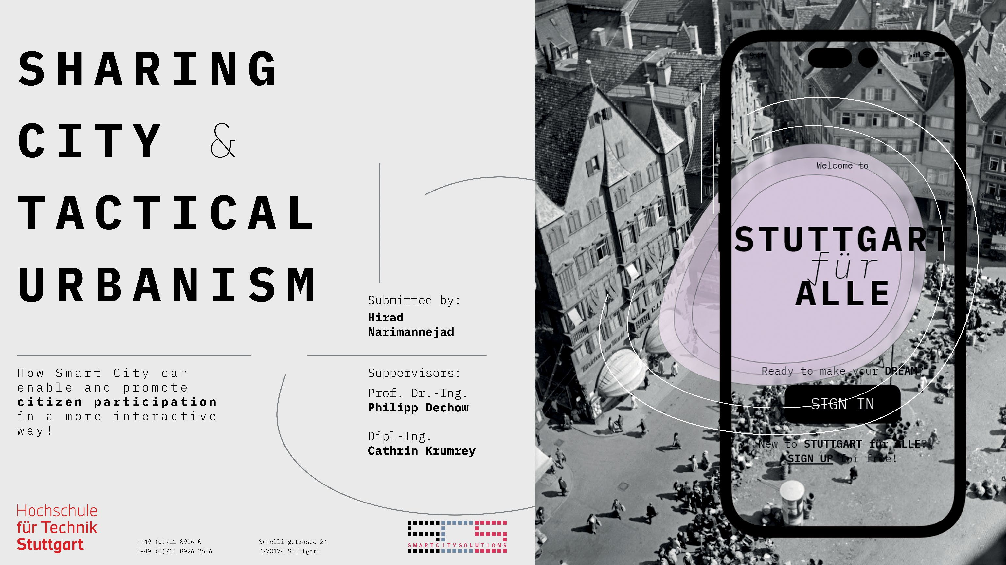
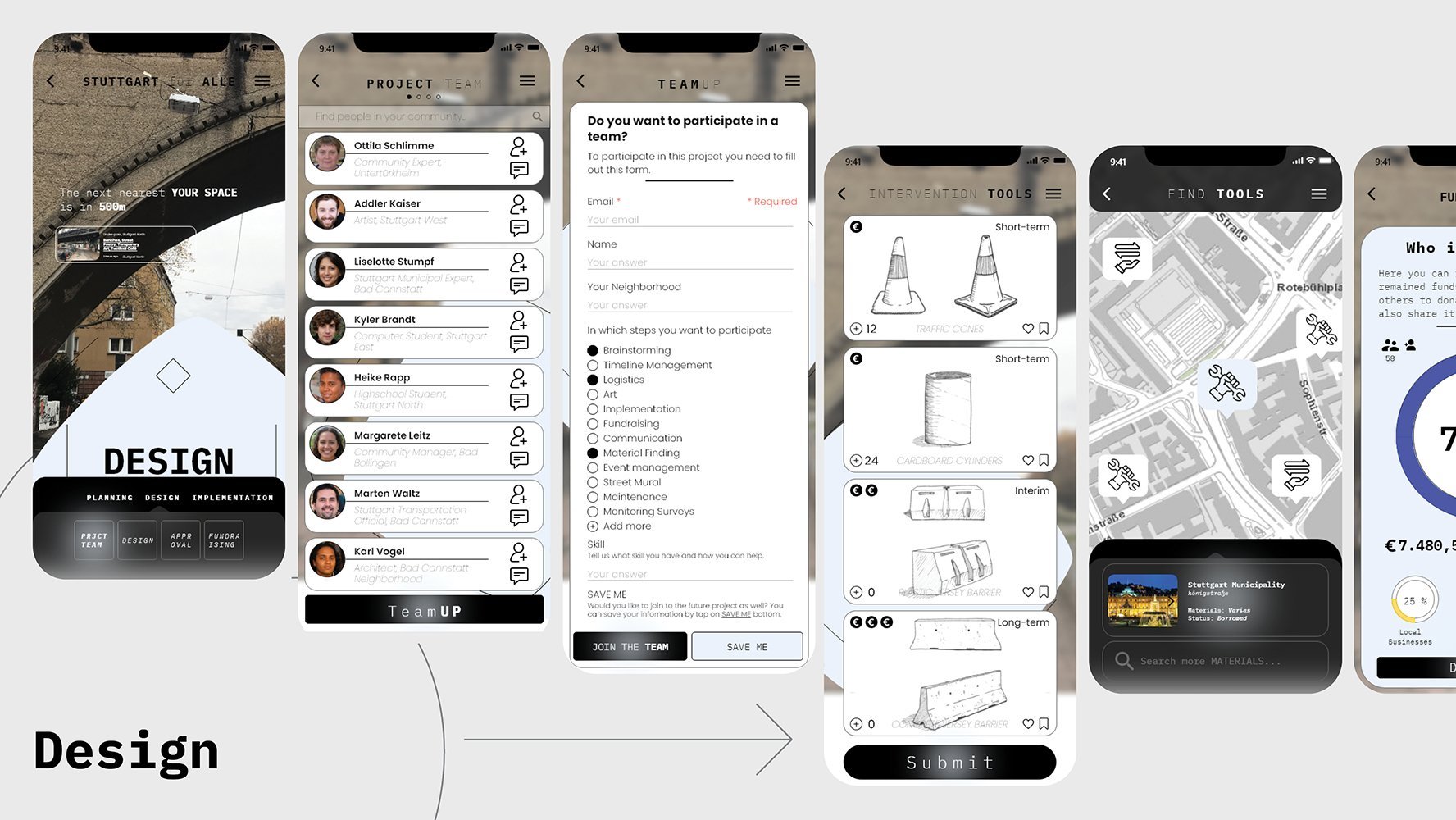
Master Smart City Solutions | Sharing City & Tactical Urbanism: How Smart City Can Enable and Promote Citizen Participation in a More Interactive Way
Full Title: Sharing City & Tactical Urbanism: How Smart City Can Enable and…
Strategic positions in the emerging Smart City job-market
SCS graduates move to strategic positions in the emerging smart city job-market. Students enrolling at SCS have earned work experience after completing their first university degree. They are looking for exposure to new ideas, methods and knowledge outside their job which enables them to reach the next career level. SCS furnishes them with the cross-sectoral understanding of disciplines like water, energy, mobility, and IT- and data-based solutions. SCS graduates are sought after by national and international municipalities, real-estate developers, utility providers, architectural design offices, engineering firms and research institutes.
“ The Smart City Solutions program shaped my perspective as a civil engineer by showing how innovation, sustainability, and digital solutions work together. It combined technical expertise and forward-thinking strategies to design adaptive, inclusive, future-ready cities. Working with diverse backgrounds inspired valuable perspectives and ideas for resilient urban environments. ”
Aybars Dag
Civil Engineer, Türkiye
“ I joined the SCS program to learn new ways of thinking about urban sustainability. The program has exceeded my expectations. One of the most rewarding aspects has been working alongside and learning from professionals from all over the world. The diversity of experience and perspectives brought so much depth to the learning process. I’m excited to use the knowledge I’ve gained to contribute to meaningful, future-focused change. ”
Erin Cotter
Engineering Coordinator in Local Government, Australia
“ The Smart City program enhanced my background in architecture, where I’ve worked as both a designer and supervisor. It helped me take that experience further, toward more sustainable, strategic, and interdisciplinary approaches for building smarter and more resilient cities, alongside professionals from around the world to shape inclusive, flexible solutions for the cities of tomorrow. ”
Farideh Aminian Toosi
Architect, Iran
“ Smart City Solutions helped me shift from traditional thinking in architecture and urban planning to a future-oriented mindset. I learned how digital tools and smart infrastructure can make planning more efficient, resilient and make cities more responsive. It’s no longer just about spaces, but it’s about the systems that serve people better. ”
Jayasurya Sriramaneni Hari Babu Naidu
Architect, India
“ As an architect, I have always believed buildings are meant to be designed to connect with their users and create a journey. The SCS master’s programme showed me that smart solutions share the same principle as they go beyond technology to shape everyday experiences, improve quality of life, and promote sustainable, inclusive, and human-centred cities. ”
Lona Abdulqadir Hussein
Architect, Kurdistan
“ With my background in architecture, joining the SCS program felt like a natural next step. It helped me see cities not just as physical spaces, but as dynamic systems shaped by people, data, and technology. I really appreciated the mix of disciplines, it challenged the way I think and gave me new tools to approach urban challenges in a more holistic and forward-thinking way. ”
Yosri Kaabar
Architect, Tunisia
Scholarships at HFT Stuttgart
Scholarships
A limited number of scholarships are available to all students of HFT Stuttgart. Students qualify with an outstanding academic performance, demostrated social commitment and special personal circumstances. Students can apply only after enrolling in the curriculum.
Scholarship types:
Germany Scholarship / Deutschlandstipendium
3,600 € per year paid in monthly instalments of 300 € over a period of 12 months.
University foundation / Studienstiftung der HFT Stuttgart
1,500 € per year paid in two instalments of 750€ over a period of 2 semesters.
In addition to the HFT Stuttgart scholarships other organisations e.g. DAAD offer attractive scholarships for which you can apply prior to arriving in Germany.
What kind of “first university degree” qualifies for SCS?
SCS is a multidisciplinary programme. Applicants from a broad spectrum of disciplines are accepted. A first university degree qualifying for a profession (Bachelor, Magister, Diplom or equivalent) in architecture, construction, infrastructure, economics and geosciences or other planning-related disciplines in the subject areas of the smart city is ideal. The university degree comprises at least 210 credit points or equivalents to the European Credit Transfer and Accumulation System (ECTS), which corresponds to a full-time study programme of 7 semesters. In the case of degrees from other disciplines, an examination is carried out by the selection committee on a case-by-case basis (see next question).
My first degree has been awarded after 6 semesters (or 180 ETCS). What to do in this case?
You must complete additional coursework worth 30 ECTS before starting the Master Programme. The workload to complete 30 ECTS equals to one semester (18 weeks) of full-time study. You can complete them at your own pace at any accredited university through distance or in-person studies, or you opt to complete them at HFT-Stuttgart during a pre-semster. For the pre-semester the fee for additional semesters of 1,000 EUR applies as outlined in the Fee Statues (in the download sections.) If you opt to complete them in Stuttgart you may apply for the Master Programme before November 15th to commence the pre-semester in March the following year. Suitable modules will be selected in consultation with the Dean of Studies.
Please review the section "Module recommendations to top-up a 180 ECTS bachelor" in the SCS Module Descriptions in the download section.
What grades from the first academic degree are expected from the candidates?
Above-average academic degrees are expected, meaning you performed above the average of your class. Proven commitment to social causes or achievements in your subject-related professional career may offset average or below-average grades. Please state this in your motivation letter.
Do I need a certificate of English language skills? What types of certificates are accepted?
Demonstrated knowledge of English language is a prerequisite. HFT accepts:
TOEFL
550 points (paper-based test)
213 points (computer-based test)
80 points (internet-based test)
The official TOEFL report can be sent directly through the Educational Testing Service (institution code: 8514).
IELTS Academic min. score 6,5
Applicants whose language of instruction is stated to be English in their leaving certificate from school, university or college, can proof their knowledge of English if the graduation certificate states so.
Is there any age limit for the applicants?
No. Candidates of all ages are welcome to apply. HFT supports life-long learning and a diverse student body.
Is an online application possible?
Yes. We only accept applications submitted by e-mail.
You may provide certified copies of your documents once you arrive in Stuttgart after being admitted.
Is any additional professional working experience required for the application?
Yes. The master programme a non-consecutive continous education programme, You need to provide proof of at least one year of relevant professional experience gained after you finished your first univeristy degree (Bachelor, Magister, Diplom or equivalent). The proof will be in the form of a certificate of employment or letter from your employer or employers if your experience was gained at different jobs.
Do I need to pay an application fee?
No. As of March 2023 you application review and the interview will be free of charge. You also do not need to pay a reservation fee. HFT Stuttgart reserves the right to change this policy.
I plan on hiring a consultant to help with my application. Is this a good investment?
HFT Stuttgart advises against outsourcing the application process for its study programmes to a service provider or consultancy.
Reasons are:
The process is straightforward and you can always ask the staff of the programm via e-mail scs-master(at)hft-stuttgart.de or call us on the phone. We are happy receiving updates on your process of coming to HFT.
In the past, students reportedly lost money to fraudulent consultants.
In the past, students arrived late or lost their study place because the manager of their account changed and did not submit their case to a successor.
In the past, students were ill advised as to which German consulate/embassy to apply for visa and as to how many instalments of tuitions payments satisfy the requirements of the German consultancy/embassy in charge of their application. This resulted in a loss of precious time and money.
Handling administrative matters related to your application yourself will prepare you to handle the administrative matters necessary after arriving in Germany.
Studying
On which days of the week will the lectures be held?
Full-time study:
Semester 1 and 2: Friday, Saturday, Sunday, Monday
Semester 3 (Master Thesis) own arrangement, some Saturdays
Part-time study:
Semester 1 and 2: Friday, Saturday, Sunday
Semester 3 and 4: Saturday, Sunday, Monday
Semester 5 (Master Thesis) own arrangement, some Saturdays
Can I apply for part-time studies?
The part-time programme is available only for EU-citizens and residents.
German immigration law stipulates that student visa shall only be issued for the purpose of full-time studies.
If you hold non-EU citizenship but have resident status through marriage you could be eligible for part-time studies. Please inquire with the relevant authorities.
Can I attend only one Module?
HFT Stuttgart is currently working to make selected Modules available and issue a certificate upon completion.
Please note that a fee will apply. Applicants must fulfill the same requirements as applicants to the full programme, specified in the Admission Statutes in the download section. Applicants to only one Module must be EU-citizens or reside in the EU with a work or spouse visa. Courses will be taught in presence at HFT Stuttgart.
Should you be interested, please contact scs-master@hft-stuttgart.de.
When are the holidays?
No lectures will take place during a 2 week Christmas break in the last week of December and first week of January.
No compulsory lectures will take place from second week of February till second week of March.
No compulsory lectures will take place in summer from second week of July till second week of September.
Can I work during my studies?
Yes. We encourage our students to work during their studies. However, you need to reserve at least one day per week for completing homework in addition to the teaching days.
If you are an EU citizen: You may continue your employment at a reduce number of workdays.
Students from non-EU countries are only permitted to work 120 full days or 240 half days per year (voluntary internships included), Those who wish to work longer require permission from the Federal Employment Agency and the Alien Registration Office. Obtaining permission depends on the labour market in one’s place of residence.
If you are a non-EU Citizen: The employment regulations for international students apply. Please check the DAAD-Homepage.
The M.Eng. you will earn is worth 90 credit points (ECTS). The optional M.Eng. MBA is worth 120 credit points (ECTS). Please compare with the admission requirements of the PhD programme you are interested to enrol in.
How is the quality of the programme ensured?
The quality of the Master Programme Smart City Solution is certified by the academic accreditation agency ASIIN e.V. (Accreditation Agency for Study Programmes in Engineering, Computer Science, Natural Sciences and Mathematics).
The ASIIN certification seal was last issued in 2018 and is valid until September 2024. HFT-Stuttgart has completed the update of the study programme and has submitted documentation for re-accreditation at the German accreditation council.
The quality is also determined by the success that graduates achieve in their profession.
How many Credit Points can I earn with design/projects?
Some scholarships ask for a minimum number of Credit Points (CP) in the area of design/projects. At Smart City Solutions it is possible to earn a maximum of 35 CP out of the total 90 CP with (architectural/ urban) design projects. In accordance with the Dean of Studies and lecturers respectively, the student can opt to fulfil the course requirements with architectural/urban design in Module 10.3 “Master Thesis Project” (23 CP) and Module 9 “Case Study” (12 CP). In order for you to do so, your first academic degree (B. Sc.) and/or your professional experience need to be in the field of architectural design to be able to complete the task in the given time. If you plan to opt for design projects, please include samples of your design in the application documents and mention it in your motivation letter and in the admission interview.
Why is German language not part of the SCS curriculum and how can I learn or improve my German?
SCS is a countinuous degree for professionals and therefore provices subjects related to smart city solutions. The curriculum has a strong international orientation and prepares students to work on international projects, which often requires English language skills. Among the students are also native Germans. Therefore, the SCS curriclum does not include German language modules.
Should you plan to seek employment with German companies after graduation, studying German with a professional teacher in your country of residency, will put you at a huge advantage. Students who arrive with no German language knowledge tend to find it hard to make time for learning the language during the semester.
HFT offers German couses with the third party provider VESPA. Intensive online German courses of various levels take place for three weeks in September and in February/March at a discounted fee for HFT students.
During the semester, German courses are offered every Wednesday afternoon for different levels. Availabiltiy is limited so make sure to register early.
Does the curriculum include a compulsory internship?
No, a compulsory internship (Pflichtpraktikum) is not part of the SCS curriculum for two reasons: (1) The programme is targeting mid-career level professionals with one year of relevant professional experience after completing their first degree, ideally more. Thus, work experience is a prerequisite for enrolling in the programme, not a new skill the programme teaches. (2) In Germany, companies hosting students for compulsory are not required to pay them, as they are considered to render a service to students by contributing to their education. It would not be conductive to professionals in a further education programme like SCS to work under such a condition. Students are encouraged to find vorluntary internships during their studies or continue to work for their existing employer at reduced hours.
What if I need to take a break during my studies for personal reasons?
Students may be granted leave of absence ("Urlaubssemester") for a good cause upon application. The duration is for the full semester. Leave of absence can be granted for up to two semesters in total for the duration of the study programme. Leave of absence must be applied for before the start of lectures of the respective semester. Administrative fees of approx. 200 € incur regardless and must be paid to keep the student status active and maintain student privileges (e.g. student health insurance, renting in the student dorm, access to library, access to canteen, etc.). No tuition fees incur during the leave of absence semester.
During the semster in which a student is on leave of absence, a maximum of 10% of CPs of the regular semester (3 CP) can be credited.
Please check Leave of absence on HFT website for detailed information.
Tuition and Payments
How much does the Master Programme Smart City Solutions cost?
The tuition fee for the entire programme is 10,000 € for both full-time and part-time students. Tuition fees will be paid in two instalments per semester. The finance department will send you payment requests with the exact amounts and payment deadlines required.
All fees, costs or expenses that are not tuition fees, such as:
- Any registration, enrolment, or other fees charged by either HFT, any of its affiliates, and/or any government agency in connection with your studies:
Student ID Card: 15 € (10 € deposit and a 5 € credit balance)
Student Services: ca. 200 € (per semester)
Costs for mandatory field-trips: approx. 600 €
- Costs depending upon your individual life-style:
Health insurance (mandatory, depends on citizenship and age, see below in the FAQ section "Living in Stuttgart")
Room, housing, meals, living expenses, travel, supplies, computer or IT equipment;
Cost of the semester public transportation ticket: 206 € (per semester)
Printing costs (your coursework)
Late-fees for registration and returning library books or failing to register for exams if applicable.
Costs to attend recommended but extra-curricular events like the Smart City World Expo and Conference in Barcelona, other trade fares and conferences.
I have a scholarship. Does it cover tuition fees?
Most German scholarships (DAAD, etc.) only cover travel and living expenses. Should you apply for a scholarship or already hold a scholarship that covers the tuition, please make sure this will be the case. In the past we had applicants who found out only after successfully completing the application process to Smart City Solutions that their scholarships does not cover the tuition fee and had to cancel. Another substantial financial position, scholarships may not cover is the deposit in the "Blocked Account" (see below).
I am a non-EU citizen. What other financial aspects do I have to consider?
1. The "blocked account" is required by German consulates/embassies/foreigner office at townhall at the time of visa application or visa renewal for some non-EU students. They will be required to open the "blocked account" aand transfer about 11,208 EURO (as of Nov. 2022) to proof their financial liquidity during their stay in Germany. This is not a fee. The money remains yours and you can withdrawn the amount later. However, you need to prepare to transfer this sum. You also will not be able to touch the money for the time the blocked account is active. If you are a scholarship holder, please make sure whether the scholarship covers the "blocked account" deposit. Since this payment is not levied by the school, HFT cannot assist with matters concerning the "blocked account".
Some German consulates/embassies (e.g. in India) require proof of funds equivalent to the tuition fees for the first two semesters. This can be either of the following:
(a) Confirmation of payment issued by the university OR (b) proof of education loan OR (c) unblocked deposit added to your blocked account (i.e. deposited in addition to the 11,208 EURO mentioned above).
We recommend you follow the steps outlined in www.study-in-germany.de/en for obtaining a student visa. It has been prepared by the German Academic Exchange Service which is an agency of the Federal Government of Germany and is frequently updated.
2. Cost of currency exchange and money transfer is another cost non-EU citizens may have to budget. Your bank at home is likely to charge for currency exchange, for transferring money to your blocked account, your tuition fee to HFT, or your living expenses to your German bank account may all come at a cost, which will not be refundable. Check with your local banks for best, safe options. To minimize costs approach the HFT Examination office to reduce the number of instalment rates for tuition payments.
The state government of Baden-Württemberg has introduced study fees for non-EU citizens of 1,500 € per semester. Do I have to pay this?
No. The master programme is a non-consecutive programme, requiring one year of work experience and is subject to tuition fees. Hence, the programme is exempt from this regulation. You only have to pay the fees mentioned under tuition fees.
I'm an Erasmus student. Can I be exempted from tuition fees?
No. SCS is a non-consecutive master programme. Hence, the acceptance into the Erasmus / DAAD scholarship programme does not waive the tuition fee.
I have refugee status can I be exempted from tuition fees?
I need funding. What funding options exist that I can confirm before I come to Germany??
Application for the scholarships offered by HFT Stuttgart is only possible AFTER students have enrolled and arrived at HFT Stuttgart and started their studies. This means that they have already made the payment for the first semester, transferred money to the blocked account (non-EU nationals), started to pay their health insurance and rent. Still, the HFT Scholarsips (Deutschland Stipendium and Stipendium Freunde der HFT) are competitive and not all applicants can be considered. For students who need to secure a scholarship before coming to Germany these are the options. All are very competitive and require about one year of planning in advance.
How much are the living costs in Stuttgart per month?
You will need around 850 € per month to cover your living expenses as of 2020.
The prices for food, accommodation, bills, clothes, and entertainment are in line with the EU average. Your monthly rent will be your largest expense. For further information please contact the International Student Office (ISO).
How can I get health insurance and how much does it cost?
Health insurance is mandatory in Germany. It is not possible to enroll at a German University without health insurance. Up to the age of 30 years you qualify for a public health insurance. If you are older than 30 years, the International Student Office (ISO) will help you to find a private health insurance.
EU citizens:
Students from EU countries usually get an International Health Insurance Card (EHIC - European Health Insurance Card) in their home country, which is also recognized in Germany (also by doctors). With this certificate, please register with another public health insurance company.
Non-EU citizens:
Students from non-EU countries need to apply for an insurance once they are in Germany.
These are two examples of public insurances. On their websites, you will find an indication of the monthly fee.
My visa has been issued. When should I arrive?
We recommend you arrive in Germany during the first half of September. September 1st is the date that will be stated on your matriculation certificate. You will need this certificate to convert your visa status issued upon entering Germany to a student resident status, to open a German bank account, to buy student health insurance and to obtain your student ID. Your matriculation number and student ID also give you access to your HFT e-mail, the student canteen, the library and e-library, the university buildings and lecture rooms, moodle, etc.
In September the German language courses of various levels will take place at a discounted fee for HFT students. M sure not to miss this opportunity, particularly if you plan to seek employment with German companie in the future.
What will my first days in Stuttgart be like?
The International Student Office (ISO) is the first point of contact for international students. The ISO assists with visa related questions and updates an FAQ list on topics like finding a dormitory and assigns German students as buddies to supports international students.
The ISO arranges weekly coffee breaks, regular events, and trips to bring international students closer to the German culture.
If you are an international student, the Welcome Center of the City of Suttgart will be your point of contact concerning all matters of registration of a residence permit. Please familiarize yourself with the services of the Welcome Center before departing for Stuttgart.
Where will I live?
The most common types of student residences:
Student dorms, managed by Studierendenwerk-Stuttgart (https://www.studierendenwerk-stuttgart.de/) or VSSW (https://www.vssw.de/en/). These are single rooms with shared kitchen, living room and bathroom facilities. Buildings are located at several locations. Register early to avoid the waiting list. Monthly rent (including utilities) can be around 287-340 Euros. A deposit of 400 Euros will be returned after moving out. Most dormitories enforce an certain age limit. Make sure you check when applying, should you be 30 years or older.
Apartments owned by private landlords, either rented by student cohabitations that select their flatmates, or entire apartments. Both are advertised online. Furnished rooms or apartments are rare in Germany. Beware of fantastically low prices as they may be scams.
What will my commute from the dormitory to HFT be like?
Commuting time:
Student dorms are located all over the city of Stuttgart. They can all be reached easily by public transportation Verkehrsverbund Stuttgart (VVS). Our students spend an average of 20 to 40 minutes to arrive at HFT.
Cost of transportation:
For about 206 € the city of Stuttgart offers a student ticket valid for 6 months which can be used on all buses and subways across the Stuttgart Region. Alternatively, the student ID card entitles you to use public transport is free of charge from 6 p.m. till 6 a.m. on weekdays, and all-day on weekends and public holidays.
Special note:
Saturdays and Sundays are regluar lecture days for students of the master programme Smart City Solutions. Please note that the frequency of trains, busses, U-Bahn and S-Bahn will be reduced on those days, particularly on Sunday mornings. You might therefore want to choose a dormitory close to the HFT Stuttgart Campus.
How many days can I work during my full-time studies?
International students from countries that do not belong to the European Economic Area will be allowed to work more days per year from 1 March 2024: 140 full or 280 half working days are possible. Read the leaflet "Job regulations for international students in Germany" here. To ensure a good learning outcome during your studies, SCS recommends you work no more than 10 hours per week in a job during the semester. During semester breaks you may work full-time (mid-February to mid-March and mid-July to mid-September).
Does HFT Stuttgart guarantee a job placement during studies or after graduation?
Germany has a free market economy. Getting hired by a company or public entity depends on motivation, initiative and qualifications of the applicant as well as on the overall demand for labour. Therefore, HFT Stuttgart or the SCS office cannot guarantee a job placement. However, the SCS office has done its best to create favorable conditions for SCS students to find employment while studying. Among these conditions are: (1) Teaching schedule from Friday to Monday permitting to work on Tuesdays, Wednesdays and Thursdays. (2) Selection of lecturers and members of the Advisory Board keen on employing students in their companies during and after studies. (3) Experience report during the Welcome Week by lecturers with migration background on their arrival in Stuttgart and job search strategy at the time. (4) Frequently updated list of online job portals for AEC and research assistant jobs. In addition, the SCS office employs one student assistant per intake who will assist with daily matters.
Visa and other preparation
What steps are necessary to get a student visa to Germany?
The website https://www.study-in-germany.de/en/ offers detalied and current information about planning your studies in Germany for non-EU and EU nationals.
I have successfully interviewed with the programme and received my offer letter. Which embassy / consulate should I apply at?
I am an Indian applicant. I am confused about the APS certificate. Where can I find detailed information?
As of November 1st 2022 the procedure of applying for student visas for Indian nationals has changed. Since there are now long waiting times to obtain the APS certificate, we recommend applicants secure their appointment with the APS as soon as they decide to submit their application to SCS. Please check the offical website of the German diplomatic service.
Accreditation
Accreditation The quality of the master programme is assured through external accreditation conducted by the renowned academic accreditation agency ASIIN e.V. (Accreditation Agency for Study Programmes in Engineering, Computer Science, Natural Sciences and Mathematics). The ASIIN certification seal was first acquired in 2018, last renewed on 08.12.2023 and is valid until 30.09.2032. The autenticity of the accreditiation is stated in the on the ASIIN website. The Accredation Council has approved of the accredition on 27.06.2024 and isssued their statement online.




![[Image: Mariya Bodylevskaya]](/fileadmin/Dateien/Architektur-Gestaltung/_processed_/1/a/csm_Aybars_%40Maria_3b165fda33.png "[Image: Mariya Bodylevskaya]")
![Portrait of Erin Cotter [Image: Lejo George]](/fileadmin/Dateien/Architektur-Gestaltung/_processed_/9/c/csm_Erin_%40%40LejoGeorge_b4c8b7568f.png "Portrait of Erin Cotter [Image: Lejo George]")
![Portrait of Farideh Aminian Toosi [Image: Lejo George]](/fileadmin/Dateien/Architektur-Gestaltung/_processed_/4/8/csm_Farideh_%40LejoGeorge_0a800b0bd9.png "Portrait of Farideh Aminian Toosi [Image: Lejo George]")
![Portrait of Jayasurya Sriramaneni [Image: Lona Hussein]](/fileadmin/Dateien/Architektur-Gestaltung/_processed_/6/0/csm_Jay_%40Lona_4bbb739ec8.png "Portrait of Jayasurya Sriramaneni [Image: Lona Hussein]")
![Portrait of Lona Hussein [Image: Jayasuray Sriramaneni]](/fileadmin/Dateien/Architektur-Gestaltung/_processed_/1/6/csm_Lona_%40Jay_57f820801f.png "Portrait of Lona Hussein [Image: Jayasuray Sriramaneni]")
![Portrait of Yosri Kaabar [Image: Mariya Bodylevskaya]](/fileadmin/Dateien/Architektur-Gestaltung/_processed_/7/c/csm_Yosri_%40Maria_3418d8d2a0.png "Portrait of Yosri Kaabar [Image: Mariya Bodylevskaya]")



![[Image: Mariya Bodylevskaya]](/fileadmin/Dateien/Architektur-Gestaltung/_processed_/1/a/csm_Aybars_%40Maria_1034336587.webp "[Image: Mariya Bodylevskaya]")
![Portrait of Erin Cotter [Image: Lejo George]](/fileadmin/Dateien/Architektur-Gestaltung/_processed_/9/c/csm_Erin_%40%40LejoGeorge_6133989443.webp "Portrait of Erin Cotter [Image: Lejo George]")
![Portrait of Farideh Aminian Toosi [Image: Lejo George]](/fileadmin/Dateien/Architektur-Gestaltung/_processed_/4/8/csm_Farideh_%40LejoGeorge_ffae2b06b0.webp "Portrait of Farideh Aminian Toosi [Image: Lejo George]")
![Portrait of Jayasurya Sriramaneni [Image: Lona Hussein]](/fileadmin/Dateien/Architektur-Gestaltung/_processed_/6/0/csm_Jay_%40Lona_e3b760ff2a.webp "Portrait of Jayasurya Sriramaneni [Image: Lona Hussein]")
![Portrait of Lona Hussein [Image: Jayasuray Sriramaneni]](/fileadmin/Dateien/Architektur-Gestaltung/_processed_/1/6/csm_Lona_%40Jay_f168ddd96e.webp "Portrait of Lona Hussein [Image: Jayasuray Sriramaneni]")
![Portrait of Yosri Kaabar [Image: Mariya Bodylevskaya]](/fileadmin/Dateien/Architektur-Gestaltung/_processed_/7/c/csm_Yosri_%40Maria_f254168e01.webp "Portrait of Yosri Kaabar [Image: Mariya Bodylevskaya]")