Overview
Through the ‘Studium uMINTerpretiert’ (SuMINT) project, which forms part of the ‘Teaching Architecture’ funding programme, HFT Stuttgart is pursuing the overarching aim of gradually guiding students towards a professionally qualifying degree through self-regulated learning (SRL), as well as towards self-regulated research (SRF).
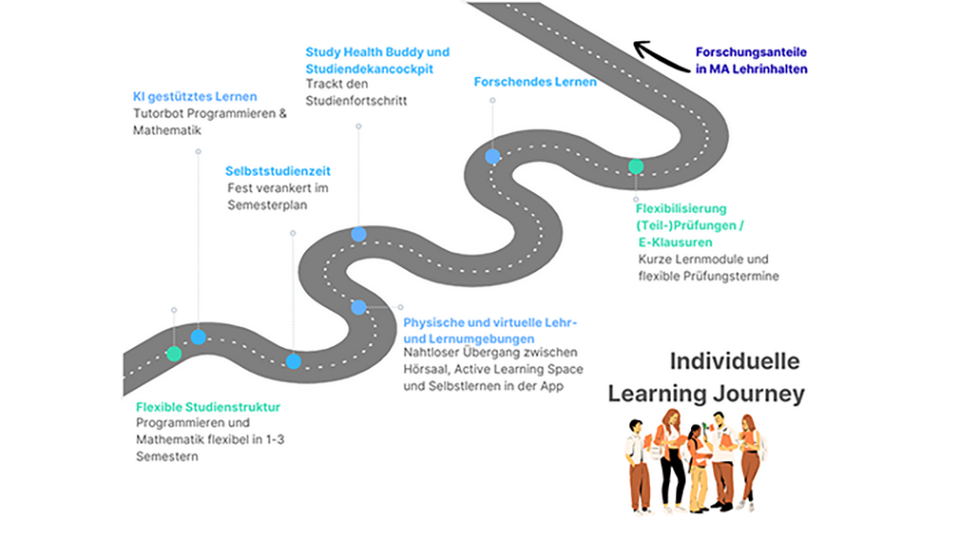
The focus is on researching and developing flexible and individualised learning structures through scalable, tailored measures that address students’ diverse educational backgrounds and life situations, such as the more flexible, personalised organisation of learning pace, study periods and examinations, supported by the introduction of microcredentials (MC) and stackability elements (STA), as well as needs-based, partly AI-based learning support tools.
The resulting individual learning journeys are supported by data-driven feedback systems to ensure that learning progress is continuously measurable, partially controllable and open to discussion. In the Master’s programmes, the project aims to incorporate research components more transparently into the curriculum in order to consistently promote research-based learning and inspire students to pursue academic careers.
Research questions
Research question 1 (F1): How can the flexibilisation of study periods and examinations be structured within resilient and sustainable study progression frameworks?
Research question 2 (F2): How can data-driven feedback systems be used to provide targeted support and encourage students’ individual, self-regulated development of competencies throughout their studies?
• Research question 2a: Where can AI-supported systems for competence development be applied, and what form must they take?
• Research question 2b: How can relevant motivational mechanisms and data provide sustainable, resilient support for self-regulated learning?
Research question 3 (F3): To what extent can the integration of in-depth research content into Master’s programmes contribute to the visibility and development of academic career prospects?
Scientific approach and methods
Sub-project TV1
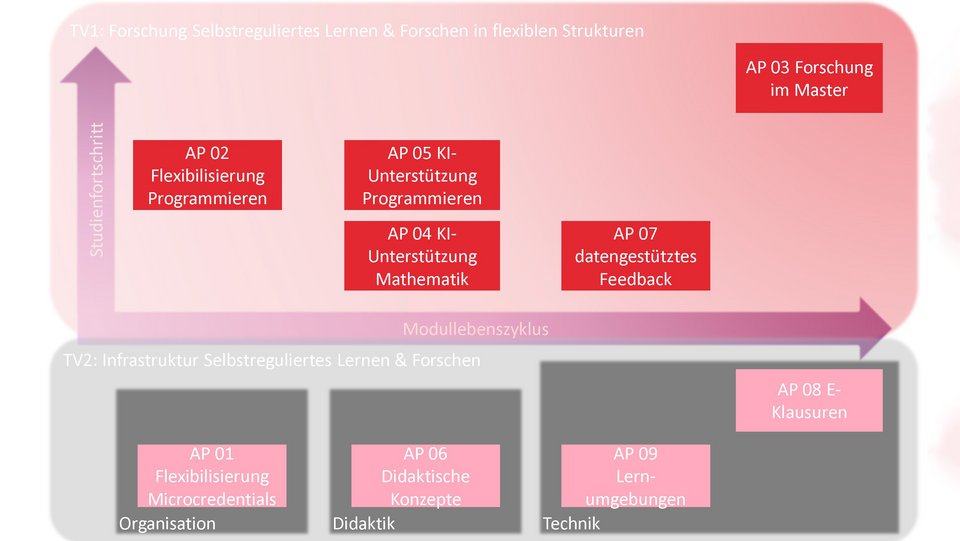
AP04 investigates how the concept of computer-assisted learning and traditional introductory mathematics lectures can be enhanced using an AI-based tutorial system. The aim is to examine how the learning process can be supported and how students can be provided with targeted support in reflection and practice. In addition, the strengthening of research-based learning in the Master’s programmes in AP03 is to be analysed and developed on the basis of current research findings and needs analyses. AP05 expands the current state of research on supporting self-directed learning independent of time and place to include linguistically interactive, subject-specialised AI systems that provide individual support and feedback.
AP07 is iteratively developing the ‘Study Health Buddy’ app, based on ongoing scientific evaluations of implemented use cases, to support students in designing their self-regulated learning according to current, scientifically sound criteria.
Sub-project TV2
In parallel with the research, the project is developing and implementing university-wide teaching and learning infrastructures to support flexible, hybrid and digitally supported study formats.
The project begins with the design and implementation of study flexibility in AP01 through the introduction of microcredentials in selected degree programmes, incorporating all internal project (interim) results and university stakeholders, as well as evaluation and transfer.
Targeted results
TV1
Result F1: Initially on a phased basis within the Computer Science programme, and from 2029 onwards extending to other programmes such as Mathematics, the decoupling of credit points (CPs) and contact hours (SWS) in all core foundation courses is intended to enable greater flexibility in study timetables and examinations. This will be achieved through the implementation of a stackability approach (STA) and the introduction of microcredentials (MC).
Result F2: By 2031, all students (starting initially with Faculty C: Surveying, Computer Science, Mathematics) will receive enhanced methodological and digital support to self-manage their competence development in relation to self-regulated learning, critical thinking, media literacy and subject-specific expertise. This includes institutional support for the learning process and timely, digital feedback on individual and programme-specific learning progress at various levels of detail. Based on our research at F2a, we understand the support needs for SRL at the beginning of the degree programme, have developed innovative, LLM-based support tools that are reliable, robust and compliant with data protection regulations, and are aware of the didactic impact of these tools. Research on F2b yields scientifically sound, tailored support tools for a broad group of students to facilitate sustainable, resilient self-regulated learning.
Result F3: As part of the project, the aim is to systematically expand the research components within the university’s curricula by 2029. Existing research components within the teaching content will be made transparent in order to actively expand research elements within the degree programmes. This will be achieved through close collaboration between research projects, higher education pedagogues and teaching staff, with the aim of strengthening students’ research skills and significantly increasing their participation in research projects at both Bachelor’s and Master’s level.
TV2
Alongside the structural measures, the project aims to design physical and virtual learning/teaching spaces that can be interconnected as required to enable a hybrid learning infrastructure. The innovation support is intended to facilitate collaborative, flexible and self-directed learning by supporting at least 5,000 user accesses per semester.


| Management | Prof. Dr. rer. nat. Melanie Baur, Prof. Dr. Anselm Knebusch, Prof. Dr. Gero Lückemeyer (Projektkoordination), Prof. Dr. Ulrike Pado, Prof. Dr. Sebastian Speiser, Prof. Dr.-Ing. Dieter Uckelmann |
| Grant No. | 1001-2166 |
| Funding | Stiftung Innovation der Hochschullehre |
| Programme | Lehrarchitektur |
| Duration | 01.10.2025 bis 31.12.2029 |
| Name & Position | E-Mail & Telephone | |
|---|---|---|
| Dean Faculty C Geometrics Computer Science Math | +49 711 8926 2519 | 2/363 |
| +49 711 8926 2654 | 2/444 | |
| Professor, Scientific Director | +49 711 8926 2632 | 7/030 |
| Course Director Bachelor of Computer Science | +49 711 8926 2520 | 2/347 |
| +49 711 8926 2812 | 2/360 | |
| Professor | +49 711 8926 2811 | 2/449 |
| +49 711 8926 2869 | 2/244 | |
| Academic Staff Member | +49 711 8926 2567 | 7/013 |
| academic staff | +49 711 8926 2995 | 2/246 |
| Research Scientist | 2/246 | |
| Teaching Methods | SkiLL | +49 711 8926 2908 | 2/244 |
