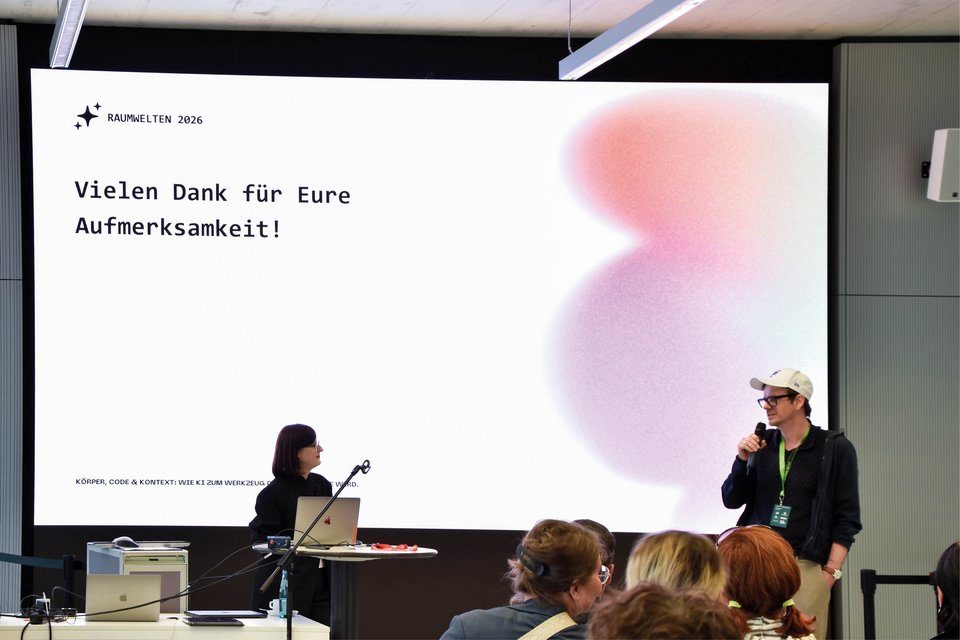
Following ten years of the event in Ludwigsburg (2012-2022), the relaunch of Raumwelten, the platform for scenography, architecture and media, has been successfully completed.
Despite a significantly smaller budget and a short preparation period, an inspiring event was successfully organised on 8 and 9 October 2026 in collaboration with the Stuttgart Technical University of Applied Sciences (HFT), Faculty of Architecture and Design. Twenty-six speakers and panellists from various disciplines explored the question of what the future of scenography, architecture and spatial production might look like in the age of AI, resilience and sustainability.
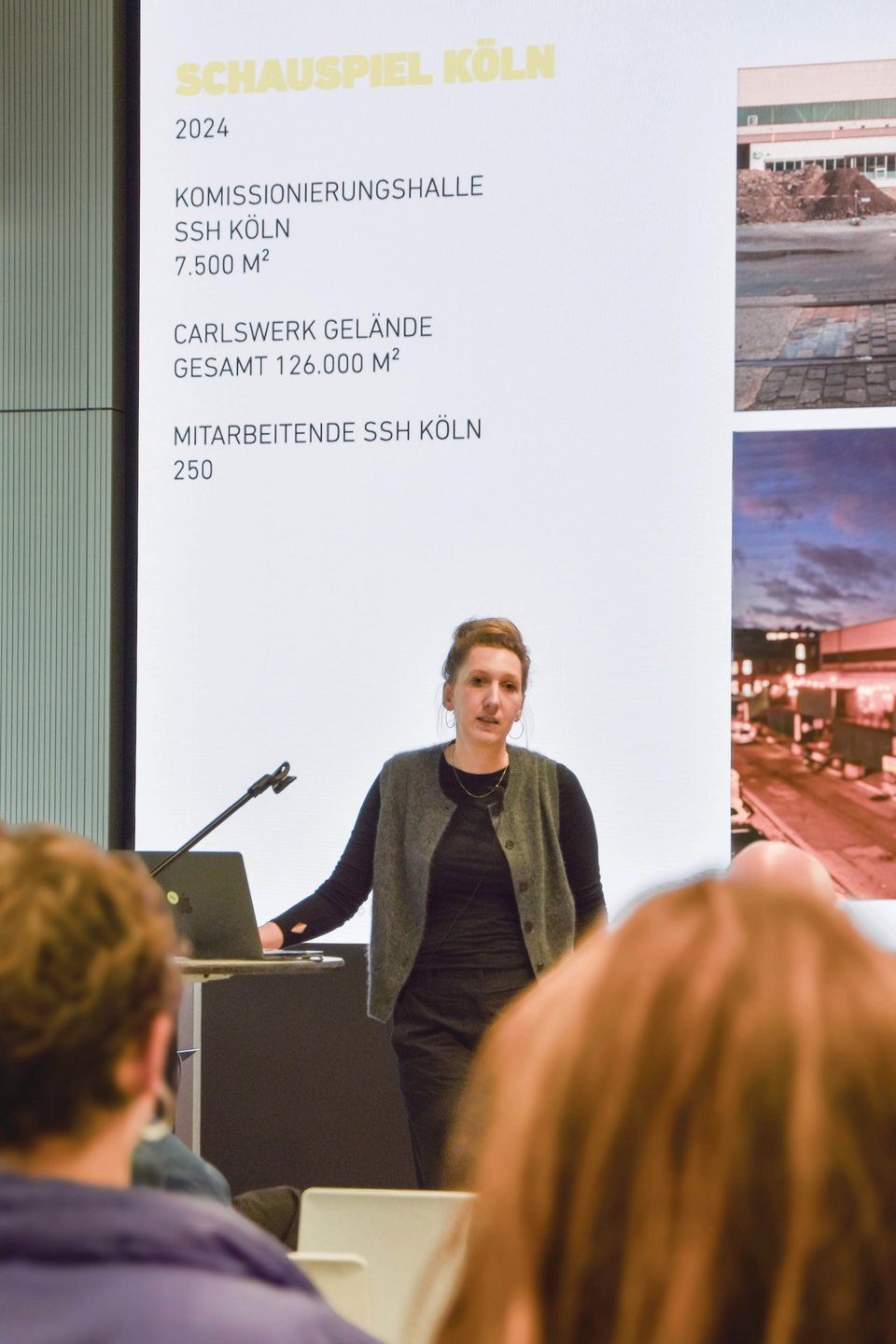
Cultural buildings, sustainability and AI
Three closely interlinked themes characterised the programme: the future of cultural buildings, sustainable architecture and scenography, and the influence of digital media and artificial intelligence on the creation and perception of space.
To kick off the event, the architectural practices Delugan Meissl (Vienna) and Atelier Brückner (Stuttgart) presented the concept and implementation of the new House of Film and Media in Stuttgart. Drawing on his world exhibition projects, including the German Pavilion at Expo Osaka 2025, Prof. Tobias Wallisser discussed the challenges of temporary cultural buildings and the possibilities of circular and modular construction.
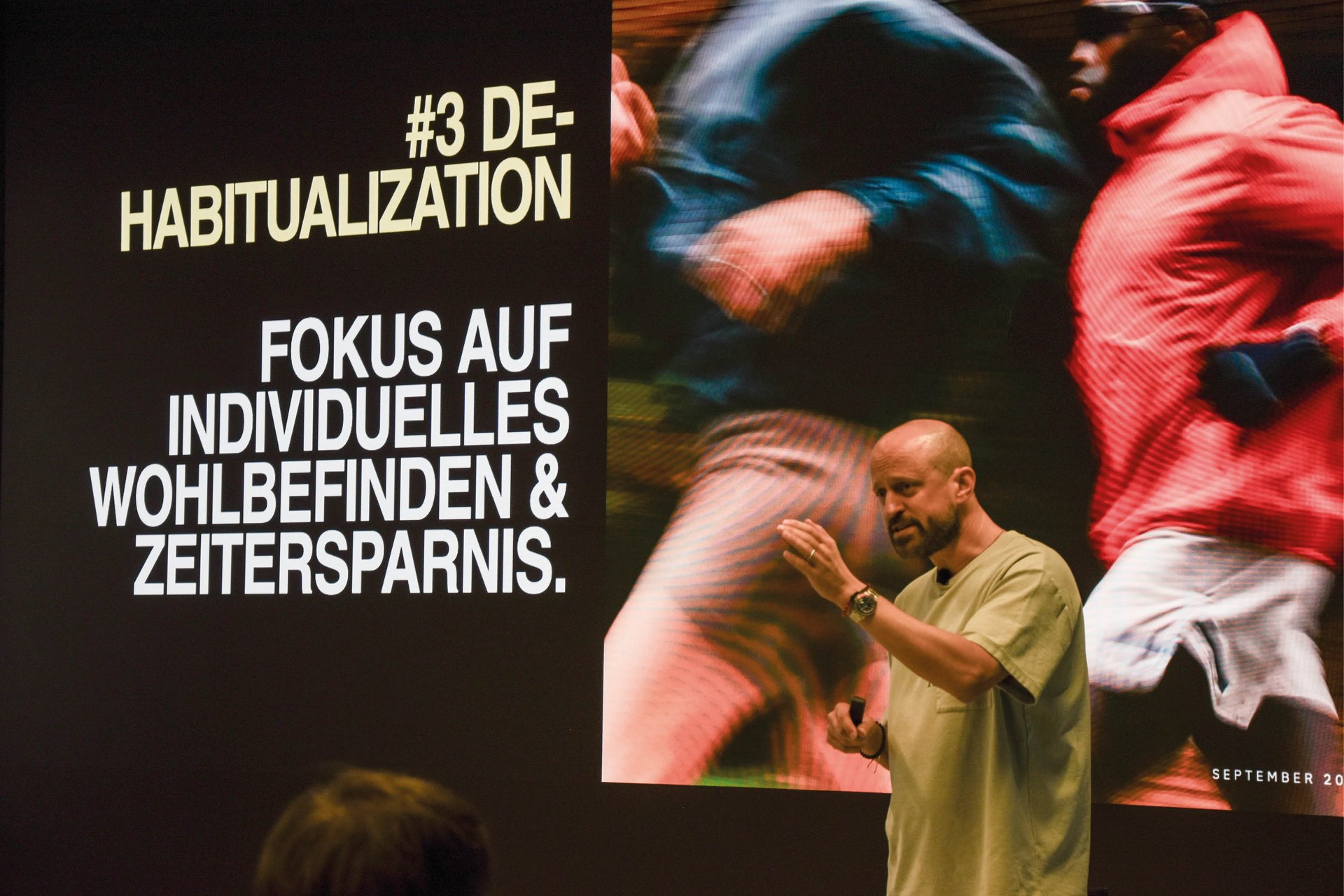
Further presentations focused on sustainable construction methods and materials (Jens Betha, Martin Haas, Martin Prösler) as well as the changes in spatial design brought about by digital technologies and AI (Thomas Hundt, Janina Poesch, Dirk Schieborn, Robert Seidel). In addition to architects, the event also featured contributions from artists, musicians, media professionals, scientists and representatives from the business world.
Cultural buildings as places of social cohesion
The panel discussion ‘KULTUR BAU STELLE – Who owns cultural buildings?’ offered a unique socio-political perspective. Five representatives from the worlds of politics, culture and architecture, including Viktor Schoner, Artistic Director of the Stuttgart State Opera, discussed which cultural buildings are necessary – in the face of tight public budgets and a growing shift to the right in society – to enable new forms of community and social cohesion.
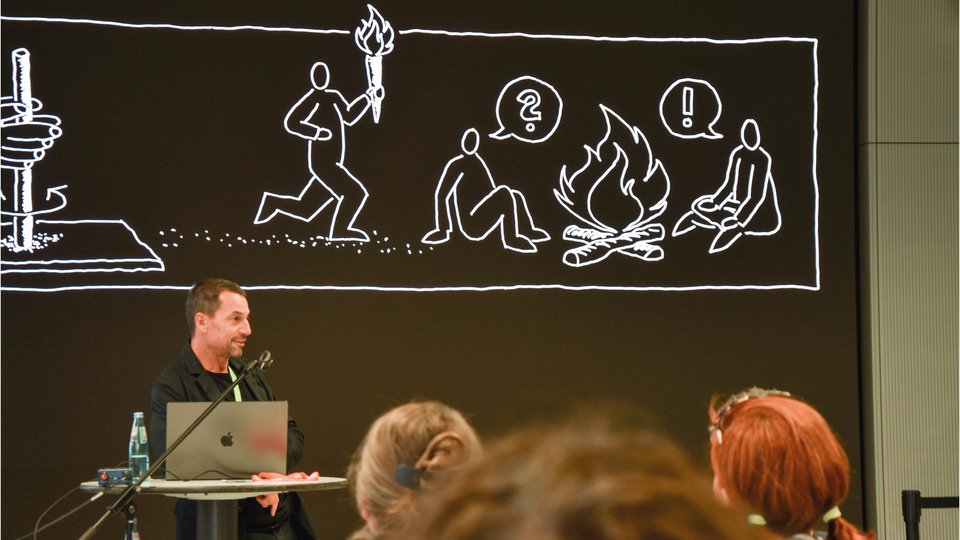
More than just a traditional conference
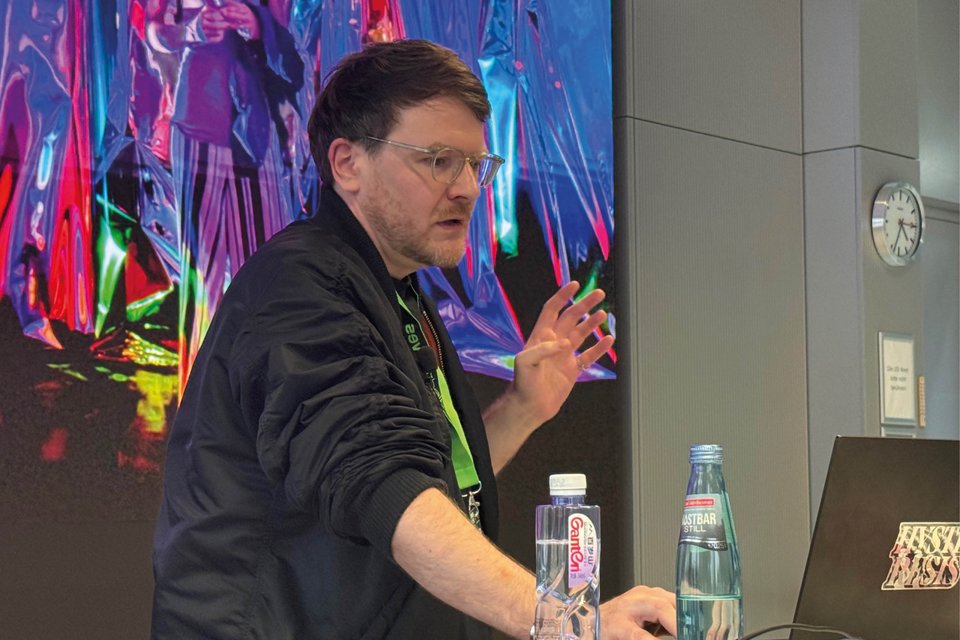
Raumwelten does not see itself as a purely academic conference, but broadens the perspective on spatial design through performances, artistic interventions and concerts. With their ‘Untitled A/V Performance’, musician Michael Fiedler and VJ Timo Dufner transformed the HFT atrium into an audiovisual sound sculpture featuring ambient and dub sounds alongside AI-generated visuals.
The involvement of the universities played a key role. Around 15 students from the HFT assisted with the organisation and documented the talks. Prof. Thomas Hundt served as co-curator and, in his talk, highlighted the significance of physical spaces and their increasing interconnection with AI, VR and XR. His colleague, Prof. Jens Betha, presented the potential of hemp as a sustainable building material. Student projects from the University of Applied Sciences Düsseldorf, Lucerne University of Applied Sciences and Arts, and the HFT Stuttgart rounded off the programme.
The students’ documentation is being compiled into a reader, which will be supplemented by essays and contributions from the speakers.
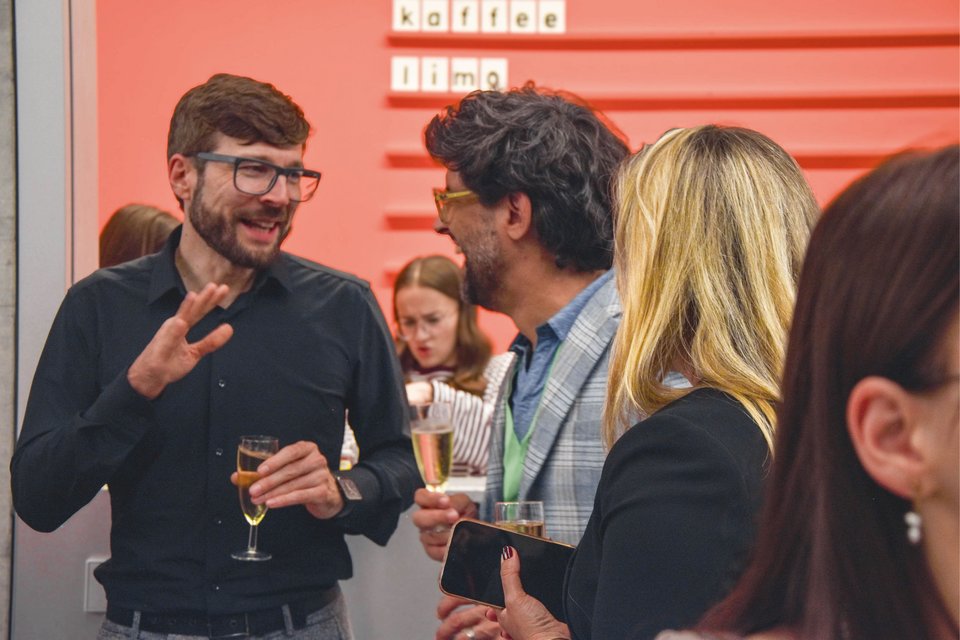
Space is the Place - between utopia and sense of place
The event’s theme, ‘Space is the Place’ - inspired by a piece of music by the Afrofuturist jazz musician Sun Ra – proved to be an apt overarching concept for the programme. The presentations highlighted just how closely the issues of sustainable design, new technologies and social interaction are intertwined. Raumwelten showcased specific projects and design practices at the intersection of architecture, scenography and media – whilst also opening up new perspectives on the question of what kinds of spaces we need for an innovative and liveable future.
Raumwelten 2026 was organised by Wegenast Kultur & Medienmanagement and supported by the Stuttgart Region Economic Development Agency and Stuttgart University of Applied Sciences. Sponsors included Atelier Brückner, the D’art Design Group and the Härle Brewery. The Art Directors Club for Germany acted as a cooperation and communications partner. Text: Prof. Ulrich Wegenast
Further information
https://www.hft-stuttgart.com/studies/fields-of-study/architecture-and-design/news/raumwelten-2026
Prof. Ulrich Wegenast
Co-curator and organiser of Raumwelten 2026