Overview
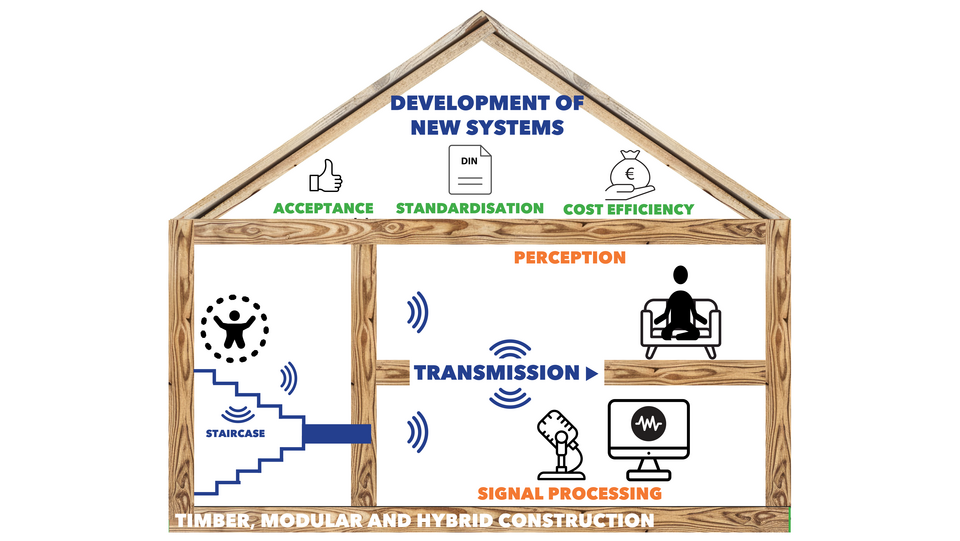
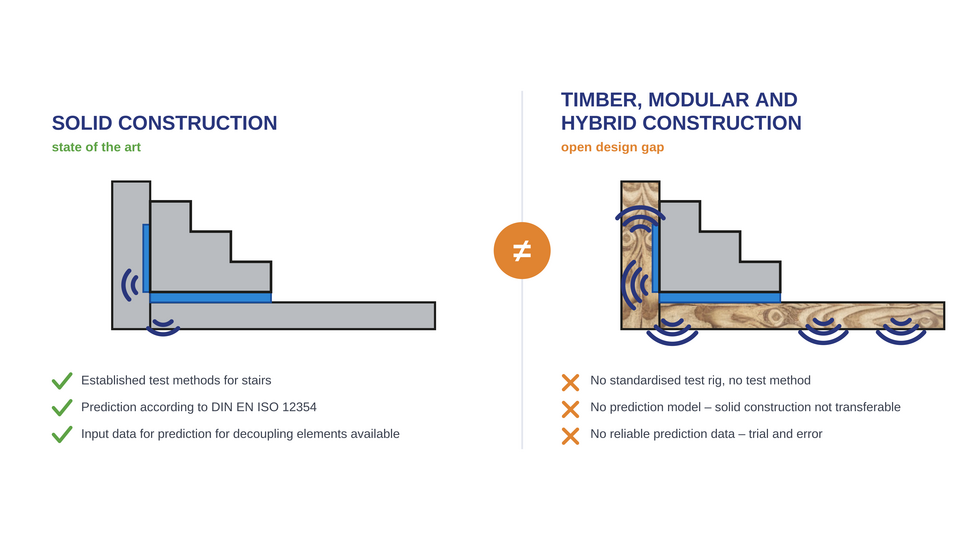
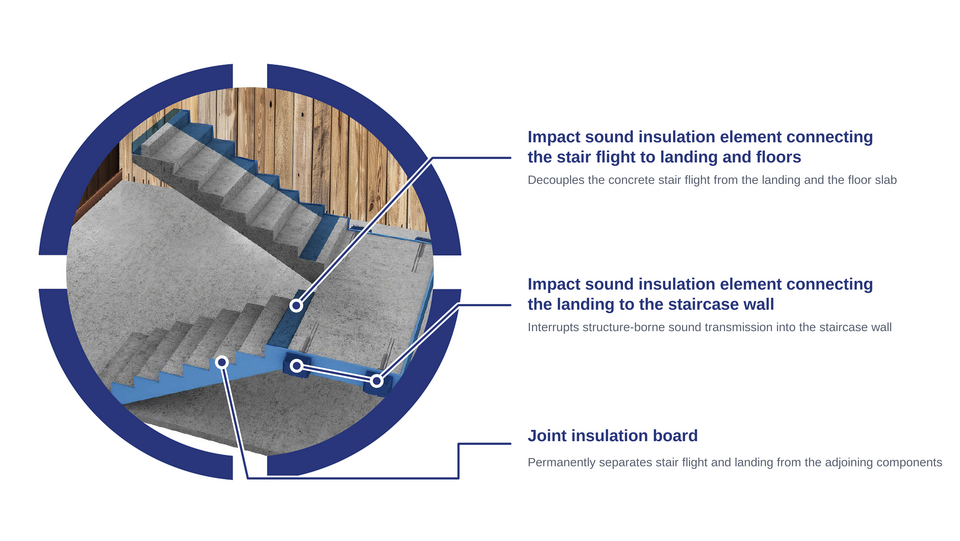
In timber, modular and hybrid (TMH) construction, solid concrete stairs are predominantly used for fire safety reasons. They transmit impact noise into adjacent living spaces – yet no design basis exists for their acoustic decoupling. Because timber floors and walls vibrate and radiate differently from heavyweight elements, solutions established for concrete construction cannot be transferred; designers and contractors are left with trial and error or oversizing. PoINTS closes this gap: HFT Stuttgart, with Schöck Bauteile GmbH and the testing institute STEP GmbH, investigate the entire transmission chain and derives test, prediction and assessment procedures from it.
Research questions
- How can solid stairs and decoupling elements in TMH construction be characterised such that the data are transferable to arbitrary building situations?
- How can their impact sound transmission be predicted for stationary and transient excitation?
- Which parameters govern the transmission, and how can decoupling elements and receiving structures be optimised?
- How does the impact noise affect residents, and which limit values can be derived from this?
Scientific approach and methods
The project addresses the complete transmission chain from the impact source to the perception by residents, combining measurement, simulation and psychoacoustics.
Starting from a system analysis of the governing parameters, the individual components – stair flights, landings, decoupling elements, walls and floors – and the complete system are characterised in the laboratory through modal analyses, transfer functions and material properties. At its core, the stair is described as an active structure-borne sound source whose characteristic data hold independently of the installation situation. To this end, the project investigates how real walking and jumping can be represented by reproducible artificial sources.
Structure-borne sound injection, the vibrational behaviour of coupled elements and sound radiation are modelled with FE and analytical approaches and validated against measurements. From these, engineering calculation procedures are derived for stationary and – via correction terms – transient excitation. In-situ measurements in timber and hybrid buildings test the prediction under real conditions and quantify uncertainties.
As the disturbing effect does not follow from building-acoustic quantities alone, binaural recordings are analysed psychoacoustically and varied on the basis of the model. Listening tests reveal which properties of the impact noise govern annoyance and yield limit values for the optimisation of decoupling elements and receiving structures. A cooperative doctorate forms part of the project.
Targeted results
- A standardisable test procedure for the acoustic characterisation of solid stairs and decoupling elements in TMH construction.
- A validated prediction procedure with engineering guidance for verifying sound insulation, including transient excitation.
- Building-acoustic and psychoacoustic limit values and sound insulation classes from listening tests.
- Optimised decoupling elements and receiving structures up to market readiness, plus a freely available calculation tool.
- Implementation of the results in national and international standards (DIN 4109, EN ISO 12354-2, EN 17823).


| Management | Prof. Dr.-Ing. Berndt Zeitler, Prof. Dr. Marco Caniato |
| Partner | Schöck Bauteile GmbH; Schalltechnisches Entwicklungs- und Prüfsinstitut (STEP) GmbH |
| Grant No. | 13HAW20PX4 |
| Funding | Federal Ministry of Research, Technology and Space (BMFTR) |
| Programme | Research at Universities of Applied Sciences (HAW) |
| Call for proposal | HAW-ForschungsPraxis 2024 |
| Duration | 01.04.2026 – 31.03.2030 |
| Name & Position | E-Mail & Telephone | |
|---|---|---|
| Professor, Member of IAF Directorium | +49 711 8926 2507 | 7/104 |
| Academic staff member / Acoustics Group | +49 711 8926 2416 | 7/112 |
