Overview
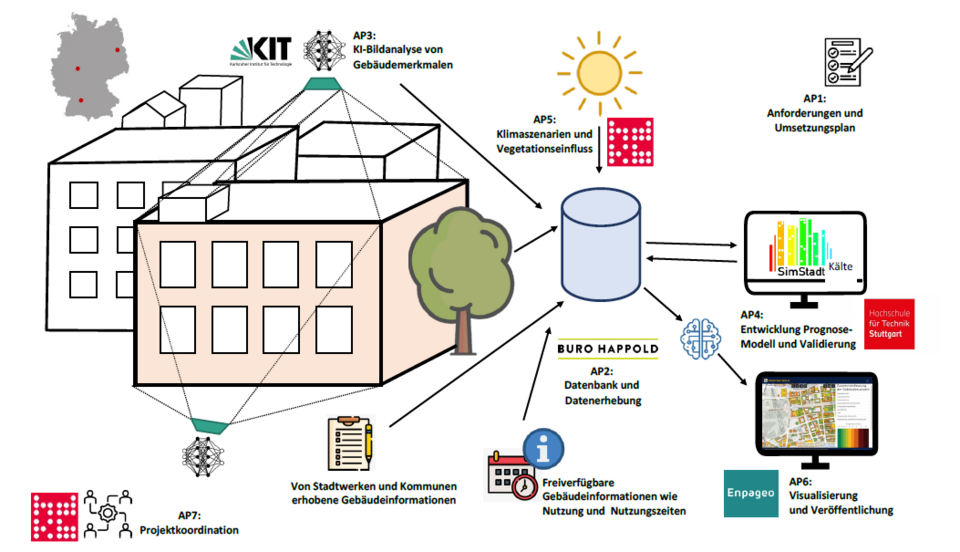
CoolingMap aims to develop a building-level cooling cadastre that forecasts future cooling loads and complements municipal heat and energy planning with the missing cooling perspective. UdK Berlin, HFT Stuttgart, KIT, Enpageo, Buro Happold, and the cities of Stuttgart and Korbach are jointly developing a data-based model for simulating cooling demand. SimStadt will therefore be extended by a module for the building-specific determination of cooling energy demand and cooling loads. In addition to analysing current cooling demand in the pilot cities of Berlin, Stuttgart, and Korbach, the project will generate projections of future demand, taking into account climate scenarios, retrofitting measures, and adaptation strategies. For the first time, CoolingMap combines AI-supported building data analysis, geographic information systems, and energy simulations to forecast cooling demand. Its integration into the existing EnergyMap Berlin platform is intended to ensure nationwide transferability and applicability in municipal planning processes. Application scenarios will demonstrate how cooling demand can be reduced and met in a climate-neutral way through PV-supported cooling, urban greenery, night-time ventilation, and summer thermal protection.
Research questions
HFT Stuttgart’s sub-project comprises the development, integration, and validation of the SimStadt-based workflow for the building-specific determination of cooling energy demand and cooling loads (WP 4), including thermal mass, coupling with PV roof effects and urban greenery evapotranspiration, and reference calculations using suitable third-party systems.
Scientific approach and methods
CoolingMap will be developed, tested, and evaluated in seven work packages. WP 1 defines the requirements. WP 2 establishes an interoperable data infrastructure. WP 3 generates data on existing cooling infrastructure and analyses building characteristics such as building age and façade features using AI-based image recognition. This will map and quantify the stock of cooling systems at city level, allowing the theoretically modelled cooling demand to be complemented by installed capacity at building level. WP 4 develops and validates the cooling demand forecasting model. The analyses focus on residential and office buildings and on building-physics-related cooling demand, excluding process cooling. WP 5 investigates the effects of the urban heat island under current and future climate conditions on cooling demand and induced additional electricity demand. WP 6 develops a freely accessible web application to visualise cooling demand and scenarios at municipal and regional level. WP 7 covers knowledge exchange, public engagement, and project coordination.
Targeted results
CoolingMap is developing an intuitive web tool for the building-specific determination of cooling demand. Beyond the project, application scenarios include municipal cooling planning, targeted incentive, funding, or sales programmes, and the expansion of CoolingMap into a nationwide cooling and heating cadastre in a follow-up project. Building on the web application and workflows developed, Enpageo and Buro Happold are expected to develop new products and services, opening up prospects for commercial use. Enpageo is willing to assume responsibility for continued operation and maintenance beyond the project duration and to keep the platform freely accessible. Identification of cooling demand and the need for cooling networks will help target neighbourhoods and develop suitable energy concepts.
Further information on the project can be found on the joint website at www.coolingmap.de.


| Management | Prof. Dr. Bastian Schröter |
| Partner | Universität der Künste Berlin, Karlsruher Institut für Technologie (KIT), Enpageo GmbH, Buro Happold GmbH, Landeshauptstadt Stuttgart, Kreis- und Hansestadt Korbach |
| Website | https://www.coolingmap.de |
| Grant No. | 03EN6063B |
| Funding | Federal Ministry for Economic Affairs and Energy (BMWE) |
| Program | 8. Energieforschungsprogramm – Gebäude |
| Duration | 01.04.2026 – 31.03.2029 |
| Name & Position | E-Mail & Telephone | |
|---|---|---|
| Professor | +49 711 8926 2371 | 7/028 |
| Academic staff member | 7/005 | |
| Academic staff member | +49 711 8926 2474 | 7/010 |
| Academic Staff Member | +49 711 8926 2334 | 7/004 |
| Academic staff member | +49 711 8926 2784 | 7/106 |
