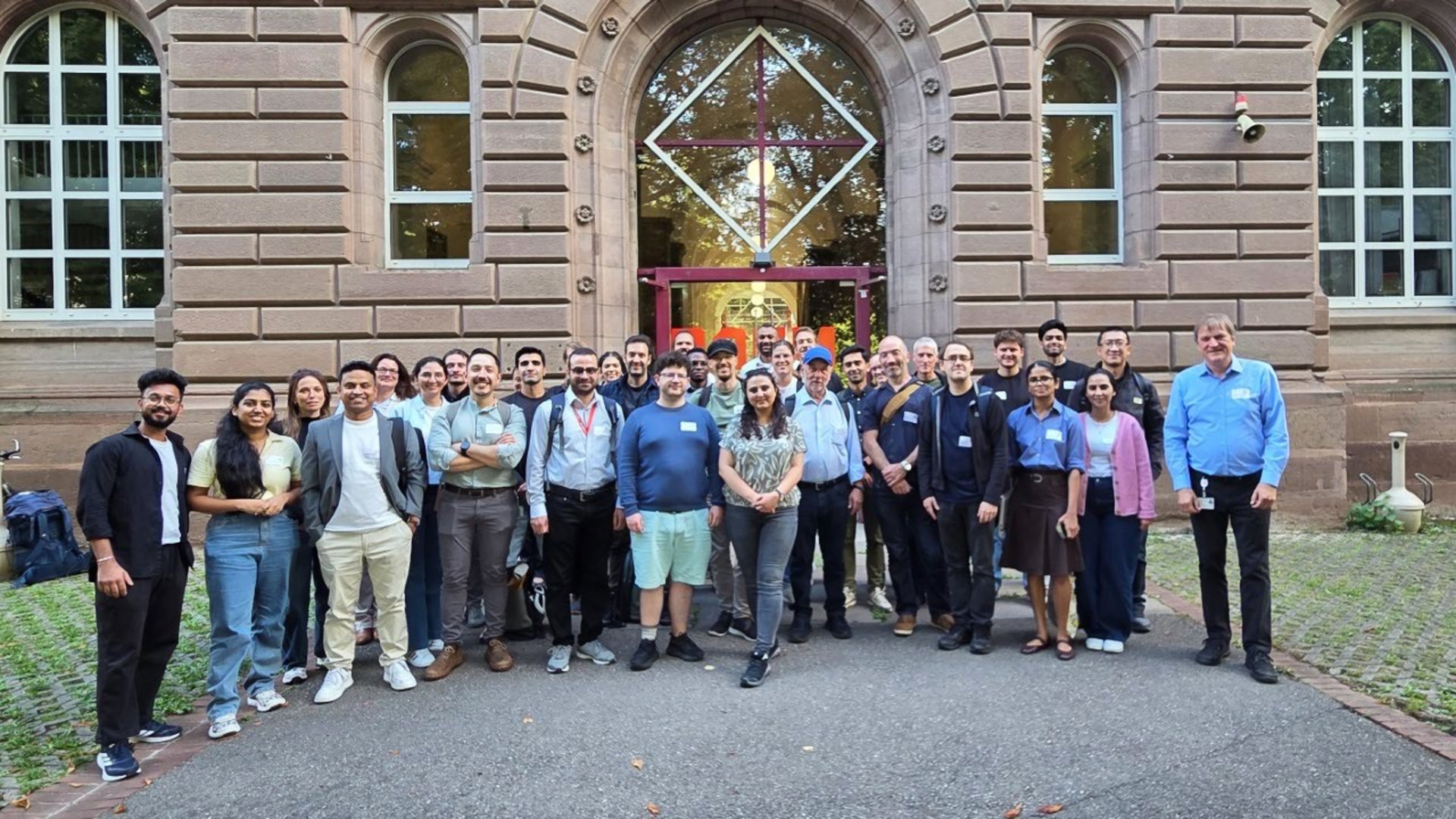
On 17 and 18 September 2026, SimStadt Next brought together researchers, students, developers and industry professionals at Stuttgart Technical University of Applied Sciences. The event focused on urban energy simulation, GeoAI, urban digital twins and citizen participation. A particular milestone: Since September 2026, SimStadt has been available as open source software under the MIT License.
How can urban simulations and digital twins help make cities more sustainable, energy-efficient and resilient? This was the guiding question of SimStadt Next 2026, which brought together around 55 participants, including students, researchers, software developers and practitioners from the SimStadt community. Over two days, participants explored current research and applications, discussed new methods and exchanged ideas about the future of SimStadt.
SimStadt is an urban simulation environment developed at HFT Stuttgart through several research projects and partnerships for energy analysis at the building, district, city and regional scales. Using 3D city models based on the Open Geospatial Consortium's CityGML standard, it supports applications such as urban energy demand calculations (thermal and power), building refurbishment scenarios, renewable energy potential and energy grid simulations.
An important milestone for its future development is that SimStadt has been available as open source software under the MIT License since September 2026. This makes the software more accessible and allows users and developers to extend existing workflows and contribute new applications. More information is available on the SimStadt website: https://simstadt.hft-stuttgart.de/.
Day 1: Share and Shape the Future of Urban Simulation
Day 1 started with an optional SimStadt for Beginners tutorial by Eric Duminil and Matthias Betz, giving new SimStadt users a practical introduction to the software and its core features. Prof. Dr. Volker Coors officially opened SimStadt Next with a brief look at the development of SimStadt, from the original SimStadt project (2012-2015) through SimStadt 2.0 (2017-2020) to its current use in several national and international research projects. Both SimStadt and SimStadt 2.0 were funded by the German Federal Ministry for Economic Affairs and Energy (BMWE).
The first keynote focused on the role of digitalisation in urban energy planning. Thilo Brüggemann from GEF Ingenieur AG explained how digital models and simulation tools evolved and why tools such as SimStadt were developed. Brüggemann is also one of the key partners in the development of SimStadt, bringing a practical planning perspective into the further development of SimStadt.
The second keynote on EnergyMap Berlin x SimStadt, presented by Stefanie Segbers from Enpageo GmbH, demonstrated how the EnergyMap Berlin project uses SimStadt simulations as training data for neural networks to estimate heating demand at building level. The project aims to create a publicly accessible building-specific heating-energy cadastre for around 369,000 buildings in Berlin, including heating and domestic hot-water demand forecasts and different refurbishment scenarios.
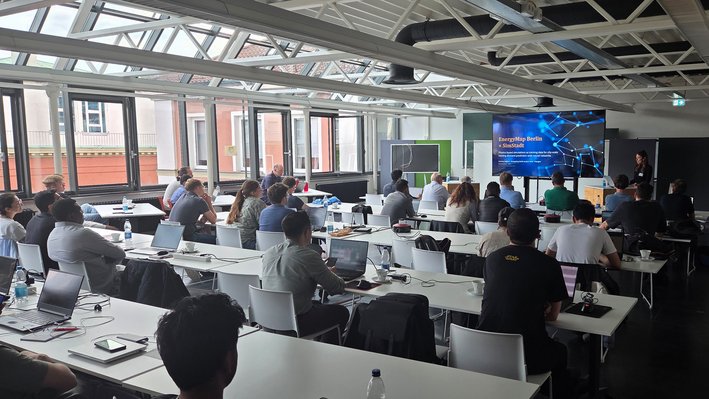
After lunch, the programme split into a Data Track and a Simulation Track, addressing two complementary sides of urban simulation: the quality and enrichment of input data and the further development of the simulation methods that use them. In the Data Track, Jeson Lonappan from Leibniz University Hannover presented LiDAR2UBEM. Urban Building Energy Models frequently rely on CityGML Level of Detail 2 (LoD2) data, while energy-relevant information such as window-to-wall ratios or storey counts may be missing. The presented automated approach combines Light Detection and Ranging (LiDAR) point clouds with existing LoD2 models, derives additional facade information, and outputs the enriched building information as CityGML with Energy Application Domain Extension (Energy ADE) attributes for subsequent urban energy simulations.
Luna Riegel then demonstrated why the quality of 3D city models is equally important. Her presentation on CityDoctor and the UDigiT-Doctor project showed that CityGML models may contain geometric or application-specific semantic and topological errors even when they are formally schema-compliant. Since the reliability of analytical results depends strongly on the quality of their input data, validation and model healing methods are an important prerequisite for robust simulation workflows.
Contributions by Muhammad Alfakhori, Juan Sardi and Céphas Mwimangire added a Mixed Reality perspective. Their work explored how heterogeneous urban information can be visualised and explored interactively within its spatial context. The presented approach connects immersive applications with 3D city models and geospatial databases, enabling building and energy information to be exchanged between a Mixed Reality environment and the underlying data infrastructure.
In parallel, the Simulation Track focused on extending the modelling capabilities of SimStadt. Sathyapriya Perumal presented an approach to extend SimStadt with dynamic energy simulation using EnergyPlus. EnergyPlus is integrated as a dedicated step within the SimStadt workflow and operates on the building information already pre-processed by SimStadt.
Using the SektorSim³ research project as an example, Janine Singer demonstrated how high-resolution building load profiles can be coupled with distribution-grid models. The project investigates the uptake of electric vehicles, heat pumps and rooftop photovoltaics and connects the resulting electricity-demand projections with a distribution-grid model.
Benjamin Hueber expanded the discussion to urban climate adaptation through his work on an active bottom-surface cooling approach. His contribution illustrated the close connections between energy, buildings and the urban climate. Thermal conditions are influenced not only by air temperature but also by factors such as radiation, airflow and humidity.
The final presentation of Day 1 focused on the role of citizen participation in the urban energy transition. Amando Reber presented insights from the European DigiTwins4PEDs project on co-creation and citizen engagement in planning Positive Energy Districts. This provided an important complement to the technical sessions: a sustainable urban energy transition depends not only on better data and simulation models, but also on how different stakeholders are involved in planning processes. Digital tools such as Urban Digital Twins can therefore support not only analysis, but also the communication of scenarios and the joint discussion of alternative pathways for districts and cities.
Day 2: Build, Test and Apply to Real-World Simulation Workflows using SimStadt
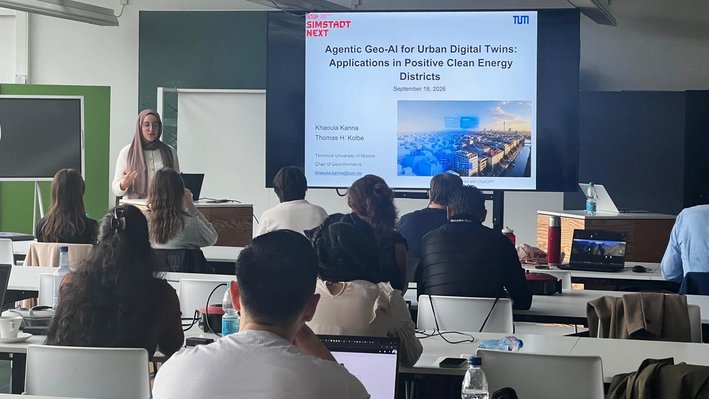
Day 2 began with the second keynote block. Khaoula Kanna from the Technical University of Munich showed how Agentic Geospatial Artificial Intelligence (GeoAI) can make Urban Digital Twins more accessible and useful for planning Positive Clean Energy Districts. Her work explored how AI agents can enrich 3D city models from heterogeneous external sources, enable non-experts to query Urban Digital Twins using natural language, and support interaction with urban and energy data. SimStadt was used in the presented use case for the Harthof district to calculate building-level energy indicators from CityGML LoD2 models.
Sally Köhler from FÜNF PROZENT GmbH then brought a practice-oriented perspective through her presentation on Research Meets Practice: Use cases from FÜNF PROZENT. She explained how SimStadt results are used to generate energy-performance profiles for residential buildings. The approach provides homeowners with an initial, building-specific orientation on energy improvements while helping municipalities communicate energy-transition options at scale. Her presentation also highlighted lessons from practical deployment, including the importance of keeping information understandable, developing solutions that scale to many buildings and continuously improving them through user feedback.
The programme then continued with a second SimStadt for Beginners tutorial and an open discussion led by Eric Duminil and Matthias Betz, during which participants could work with their own data. Building on the hands-on session from the first day, this component allowed participants to apply what they had learned to their own datasets and discuss practical questions arising from their specific use cases.
In the afternoon, during the SimStadt in Research session, Eric Duminil showcased workflows from the CircularGreenSimCity project. The project takes a more integrated view of sustainable neighbourhood development by examining interactions between energy, mobility, life-cycle assessment, urban greenery and water. A new GreenWater workflow in SimStadt links urban trees with building energy and water demand, including effects such as evapotranspiration, irrigation requirements, evaporative cooling and impacts on building energy demand. The project also explored how changes in mobility can free up urban space for additional greenery and showcased a web-based tool for configuring, comparing and visualising neighbourhood scenarios across mobility, urban greenery, buildings and energy.
Rushikesh Padsala then presented approaches for systematically integrating energy data and simulation results into Urban Digital Twins using the CityGML Energy ADE. He also showcased a digital twin prototype for quickly comparing integrated energy-transition scenarios for a city district. Users can adjust key parameters such as rooftop solar coverage, the adoption of energy-efficient appliances, flexible appliance use and electric vehicle charging, and building refurbishment rates of up to 4% per year, including the option to switch heating systems to heat pumps. The focus was not only on 3D visualisation, but also on bringing heterogeneous urban and energy information together through standardised data models and interfaces so that it can support district energy planning and decision-making for Positive Energy Districts (PEDs).
In the closing presentation, Prof. Dr. Bastian Schröter looked ahead to future developments of SimStadt. These include scalable approaches for cooling-demand assessment, the extension of electricity-grid analyses towards industrial and commercial areas, and surrogate models for computationally intensive climate-adaptation simulations, such as urban heat island and water–green–building interactions. Trained on results from detailed SimStadt and coupled simulations, these models could enable much faster evaluation of urban scenarios.
SimStadt Next therefore demonstrated the growing breadth of urban simulation: from 3D city models and the quality and enrichment of urban data to physics-based and dynamic energy simulation, GeoAI, Urban Digital Twins and citizen engagement. Connecting data, models, software, research, practice and society is critical if the urban energy transition is not only to be analysed, but co-created.
With SimStadt now open source, collaboration also extends to the software itself. New users, researchers, developers and practitioners can apply SimStadt, build on existing approaches and contribute to the future development of the platform. SimStadt Next therefore was not only a showcase of current research and applications, but also a starting point for a more open and connected SimStadt community.
The SimStadt Next 2026 event was organised as part of the HIRE project, which is funded by the Federal Ministry of Research, Technology and Space (BMFTR) under grant number 03FHP206.
The complete programme for SimStadt Next 2026 can be found here:
