Artificial intelligence tools are becoming increasingly common in the field of geomatics. This includes courses tailored to surveying or geoinformatics, as well as the opportunity to apply the acquired knowledge in the GeoAI lab in a practical setting. We would like to present a research example related to vegetation mapping in urban areas, which originated as a course project.
Artificial intelligence (AI) is now ubiquitous - including in surveying and geoinformatics applications. AI methods help with the analysis of large and complex data sets, such as satellite and aerial images.
Teaching the basics of AI is a central component of all surveying degree programmes at HFT Stuttgart. The concepts and methods of supervised and unsupervised learning form the basis for this. In unsupervised learning, methods group data according to similarities, for example similar spectral properties. This can be used to find areas in image data that are covered with similar materials. In supervised learning, models are trained to find already known classes in the data. To enable this, the method is shown examples on the basis of which it then learns its task. Such methods are used in the classification of image and other data. Traditional methods such as Maximum Likelihood, k-Nearest Neighbour and Random Forest are taught and used, as well as modern neural networks. The aim of each course is to teach both the theoretical foundations and practical applications.
For the application of AI methods, especially for the training of neural networks, powerful computers with suitable graphics cards are required. The appropriate infrastructure is made available to students in the GeoAI lab at HFT Stuttgart.
As an example of the successful teaching of AI methods in the field of surveying, we would like to cite the following research contribution, which was developed in collaboration with Stadtmessungsamt Stuttgart (City Surveying Office).
As part of the Remote Sensing Studio module in the Photogrammetry and Geoinformatics Master's programme, different methods for mapping vegetation in urban areas were compared. The study used high-resolution aerial image data from Stadtmessungsamt Stuttgart, which kindly provided us with the data for this project. As part of the module, the image data was independently annotated by the students (to generate sample data) and the joint data set was made available to all three projects. It turned out that the semantic segmentation and object recognition approaches work very well for recognising low and high vegetation. Further analyses also showed that the presence of a near-infrared band is not very important for the detection of vegetation and that the trained models also achieve good results on other aerial images. The results of this project will be presented at the annual conference of the German Society for Photogrammetry, Remote Sensing and Geoinformation in Mainz in 2026.
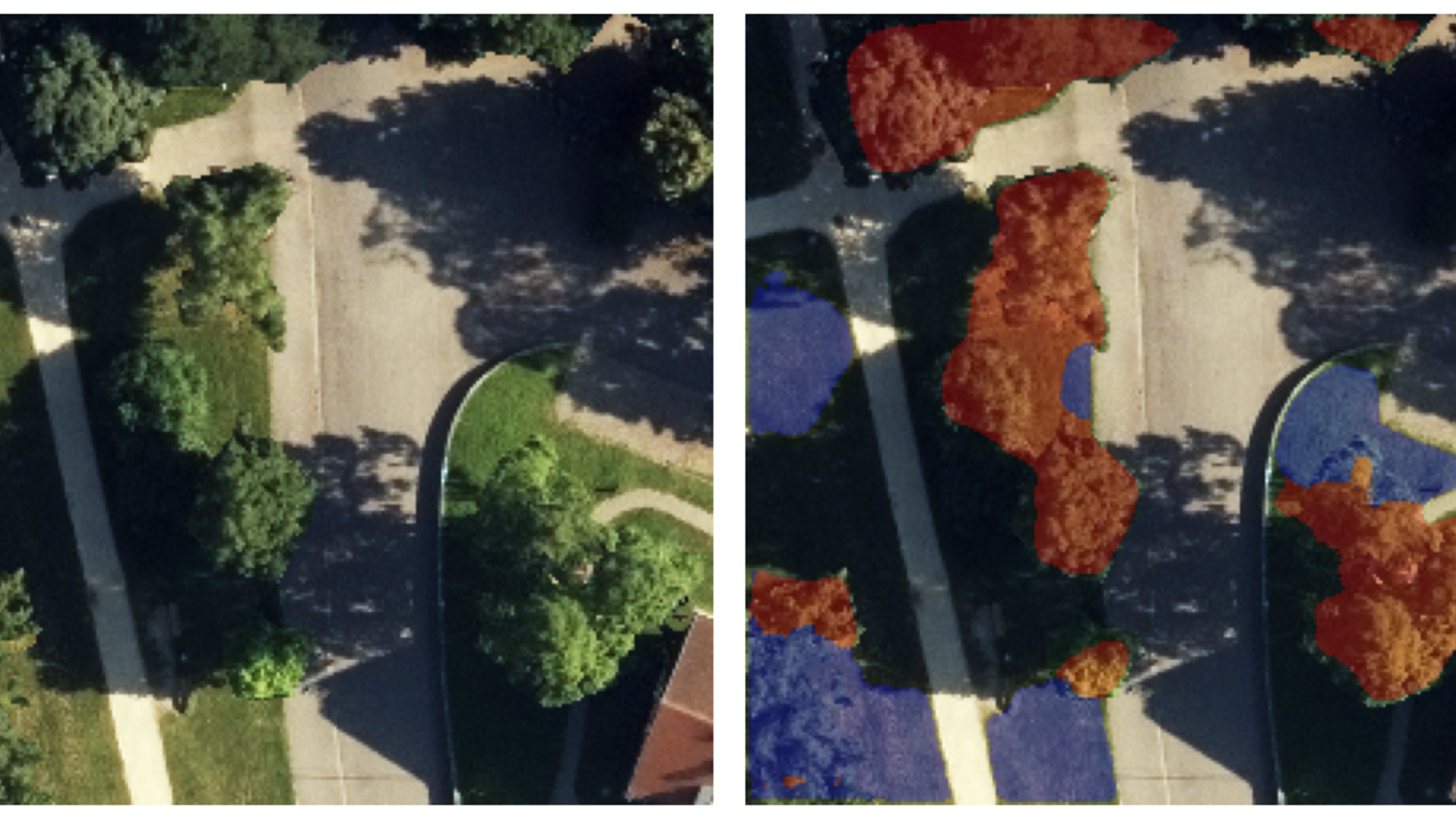
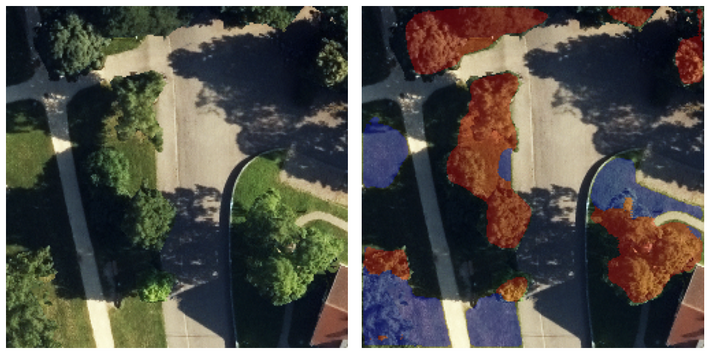
An example of the results of our segmentation model: In most cases, the model can distinguish very well between low (blue) and high vegetation (red). There are problems with correct classification, especially in transition areas and areas in the shade. Image data: Baden-Württemberg State Office for Geoinformation and Rural Development, www.lgl-bw.de, dl-de/by-2-0
![[Image: Prof. Dr. Michael Mommert]](/fileadmin/Dateien/Vermessung/_processed_/6/6/csm_profilbild_michael_mommert_2ac950d409.webp "[Image: Prof. Dr. Michael Mommert]")