Max Bell, Jonas Hille, Rubina Scherlitz, Linda Sonnenberg, Hannes Vollmer
Freiburg’s Europaviertel is a historically significant neighbourhood that is currently undergoing change. Whilst villas from the Gründerzeit era once characterised the cityscape, post-war modernist buildings now dominate the area. Our concept focuses on sustainable development through careful regeneration. The Bismarck Tower is being transformed into a model project for resource-efficient modernisation, the Terrassenhaus is being reinterpreted, and the Huji Maja is being extended. Complemented by studio flats, the result is a neighbourhood that preserves its history whilst promoting dynamic urban development.
Design Technology, Winter Semester 24/25
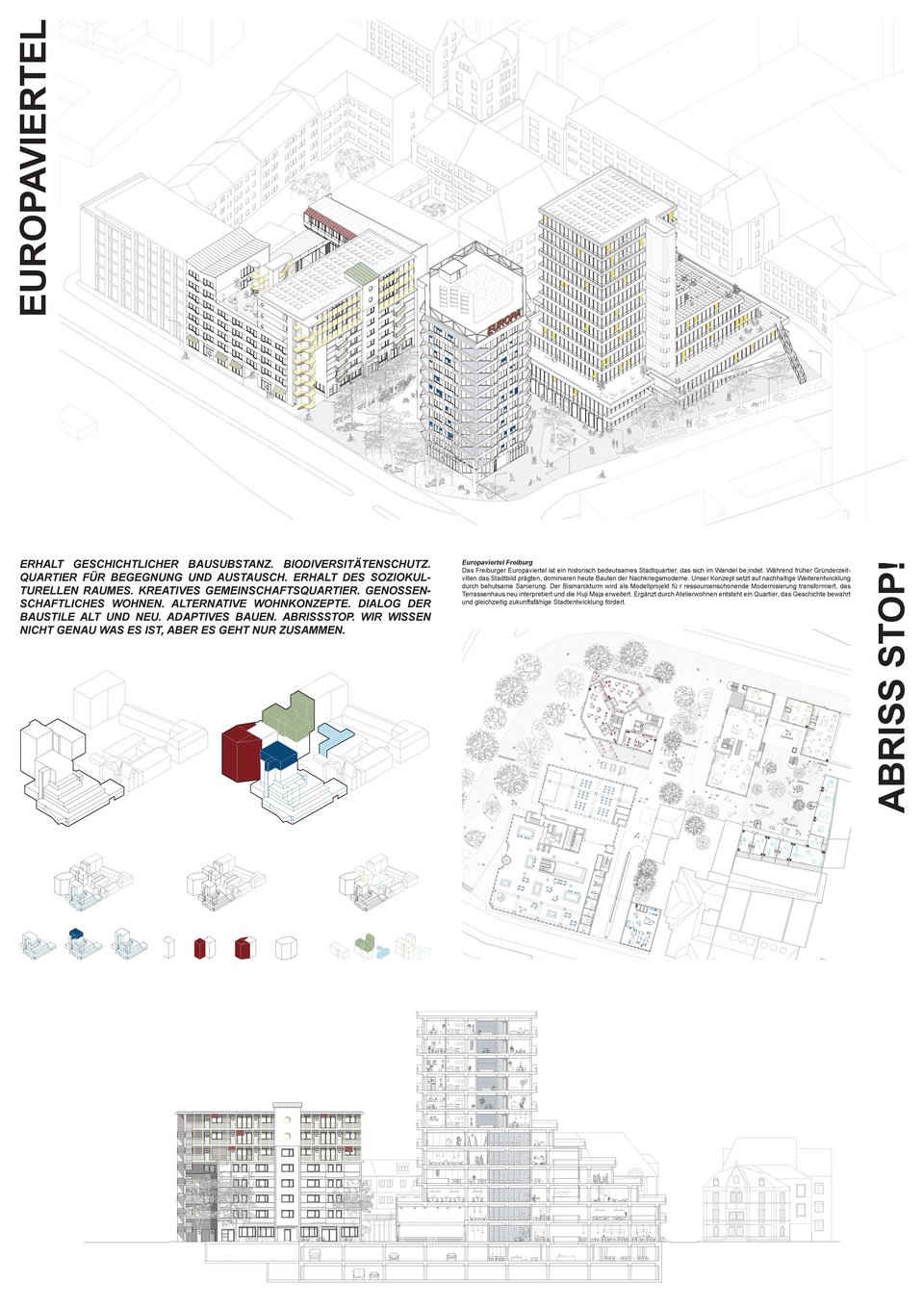
Freiburg’s Europaviertel is a historically significant neighbourhood situated in the immediate vicinity of the main railway station. Once, magnificent Gründerzeit villas dominated the cityscape; today, it is primarily buildings from the 1950s to the 1970s that characterise the area. These buildings, which are in need of renovation, are caught between the conflicting pressures of demolition and preservation. Our concept focuses on sustainable development through careful modernisation and the preservation of existing structures.
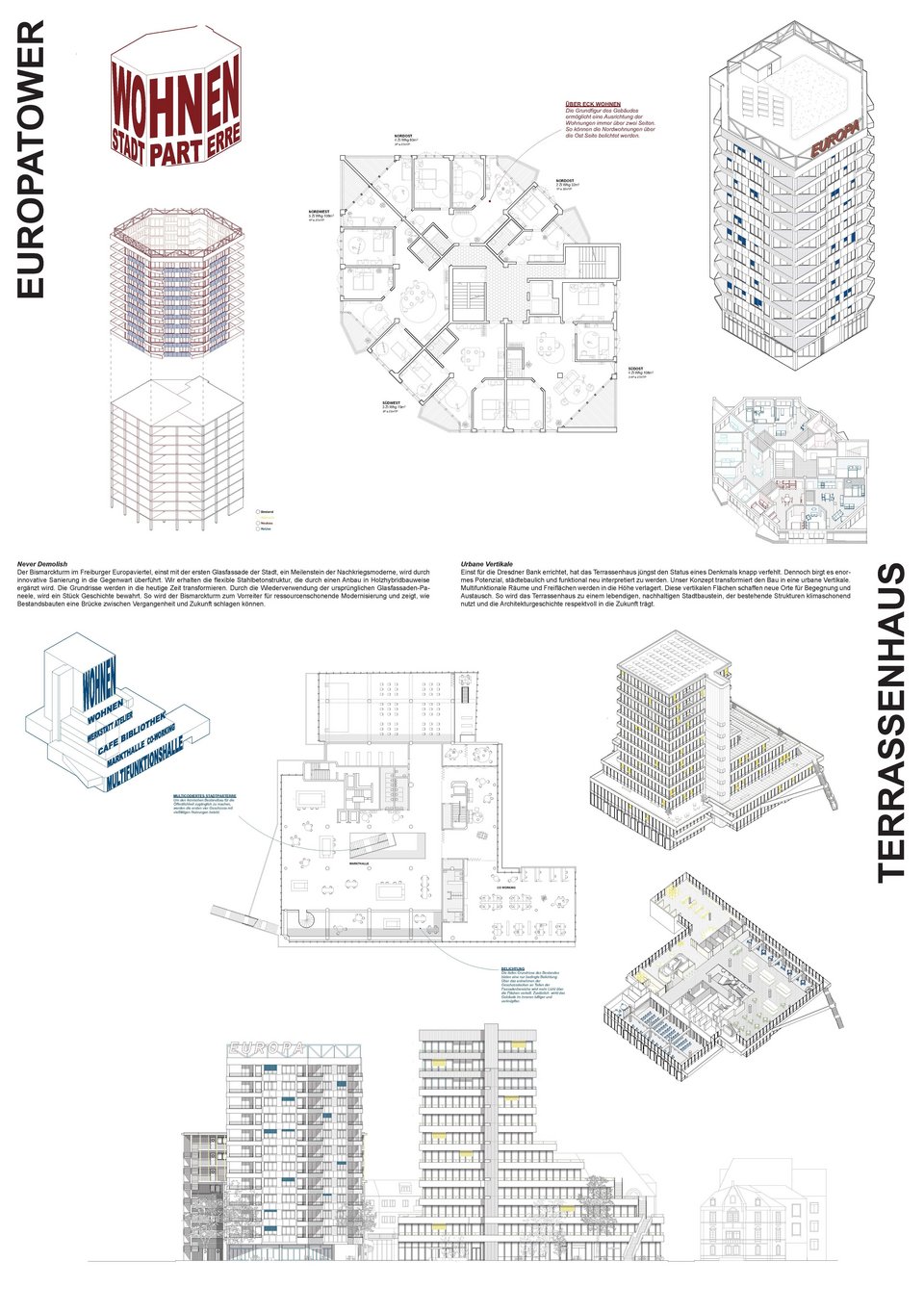
The Bismarck Tower in Freiburg’s Europaviertel is one of the city’s first buildings with a glass façade and is regarded as a pioneering example of post-war modernism. As part of an innovative refurbishment, the frosted-glass tower is being carefully adapted for the future: The flexible reinforced concrete structure will be retained and complemented by an extension using a hybrid timber construction method. Contemporary floor plans optimise the building’s potential uses, whilst the original glass façade panels will be reused to preserve the historic fabric. The Bismarck Tower will thus become a model project for resource-efficient modernisation, bringing the past and the future into an architectural dialogue.
Although the former terraced building of Dresdner Bank narrowly missed out on listed status, its potential is undisputed. Our concept transforms the building into an ‘urban vertical’, in which multifunctional spaces and open areas are shifted upwards. This creates new spaces for people to meet and interact, fostering sustainable urban development. This careful transformation preserves the building’s architectural identity whilst adapting it to current and future usage requirements. The building thus becomes a vibrant part of the neighbourhood, respecting existing structures and continuing to utilise them in a climate-friendly manner.
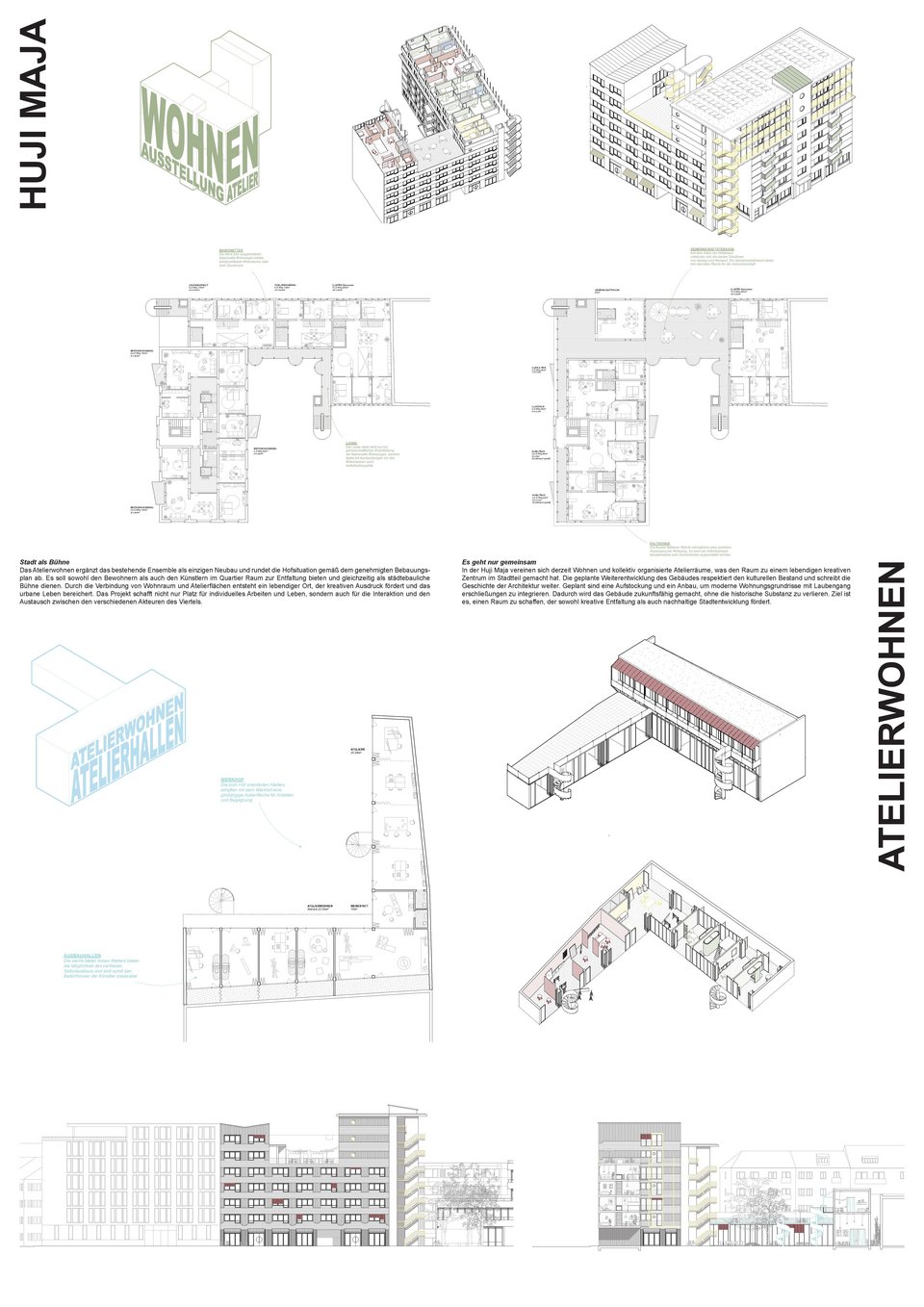
Huji Maja has established itself as a creative hub that combines residential living with communally organised studio spaces. The planned development respects this cultural heritage and expands the building with an additional storey and an extension. New flat layouts with access via pergolas allow for better use of the space and ensure long-term sustainability. This concept not only strengthens the existing creative community but also contributes to sustainable urban development by combining social housing with creative workspaces.
The studio-apartment building complements the existing complex as the only new development and completes the courtyard layout in accordance with the approved development plan. This concept creates a symbiosis of living space and studio areas, offering the neighbourhood’s residents and artists room to flourish. The building acts as an ‘urban stage’ that fosters both individual work and communal interaction.
By focusing on urban vitality and creative synergies, a unique place is created that enriches the identity of the Europaviertel and provides new impetus for urban development. The project in Freiburg’s Europaviertel exemplifies how, through careful transformation and innovative concepts, existing buildings can be preserved and made fit for the future. The combination of history, sustainability and creative spaces makes the neighbourhood a model for resource-efficient and socially oriented urban development.