Overview
The research project analyzes the planning, construction, and approval processes for civil engineering, superstructure, and building construction facilities (IOH) in railway infrastructure. The aim is to systematically record, transparently present, and critically compare both the regulatory-based target processes and the actual processes used in practice. Interactions, weaknesses, and potential for optimization are identified on the basis of national and international regulations, empirical surveys, and the analysis of a representative large-scale project. The results are used to develop practical proposals for increasing efficiency without compromising safety levels.
Research questions
- How are the regulatory-based planning, construction, and approval processes for IOH facilities structured, and what roles, responsibilities, and qualification requirements are defined?
- In what ways do these target processes differ from the procedures established in practice?
- What interactions between approval and release processes lead to delays, conflicts, or risks, especially in large-scale projects?
- What structural causes underlie process inefficiencies, especially in the case of regulatory deviations (UiG, ZiE)?
- How can processes and regulations be optimized without negatively impacting safety?
Scientific approach and methods
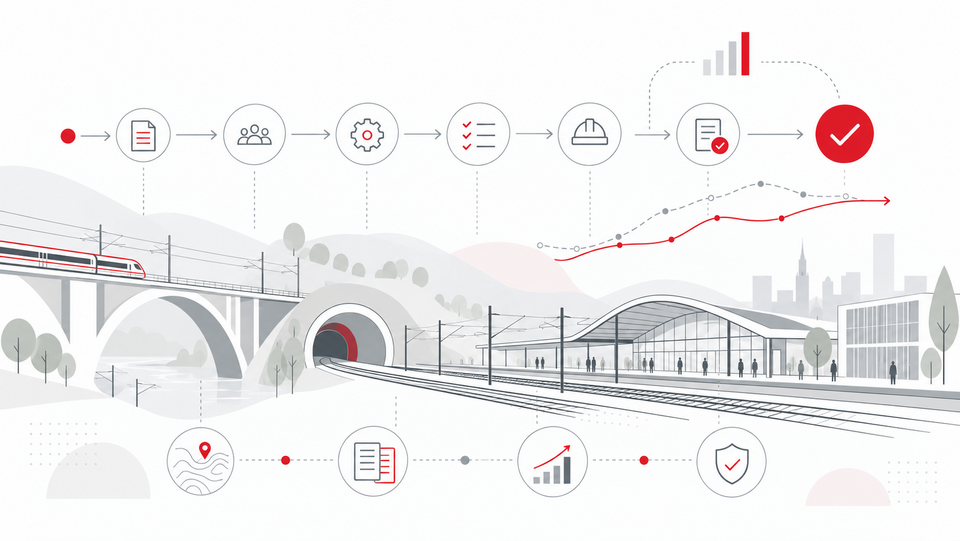
First, a systematic analysis of relevant national and international regulations and DB internal processes is carried out. The planning, construction, and approval processes are recorded in a structured manner for selected IOH sample objects and visualized using BPMN diagrams. In addition, an international comparison and a comparison with other national modes of transport are carried out.
To map practical experience, structured expert interviews are conducted with around 20 stakeholders from planning, testing, approval, and operations. The interviews are evaluated qualitatively and quantitatively to analyze deviations, interface problems, and process durations.
Based on this, the interactions of complex approval processes are examined using a major project as an example. The comparison between modeled target processes and actual processes enables the identification of points of conflict and causes for time and cost overruns. The results will be reflected upon, consolidated, and evaluated in workshops with relevant stakeholders, taking safety management (including CSM-RA) into account.
Targeted results
Transparent, uniform process models for rule-based and real-world processes for IOH systems are expected. In addition, key weaknesses, inefficient interfaces, and typical causes of delays are to be identified. Based on this, practical optimization proposals for streamlining processes, further developing regulations, and qualification requirements will be developed. The results will provide a solid foundation for more efficient approval processes, for dealing with regulatory deviations, and for further research and digitization approaches.
