Overview
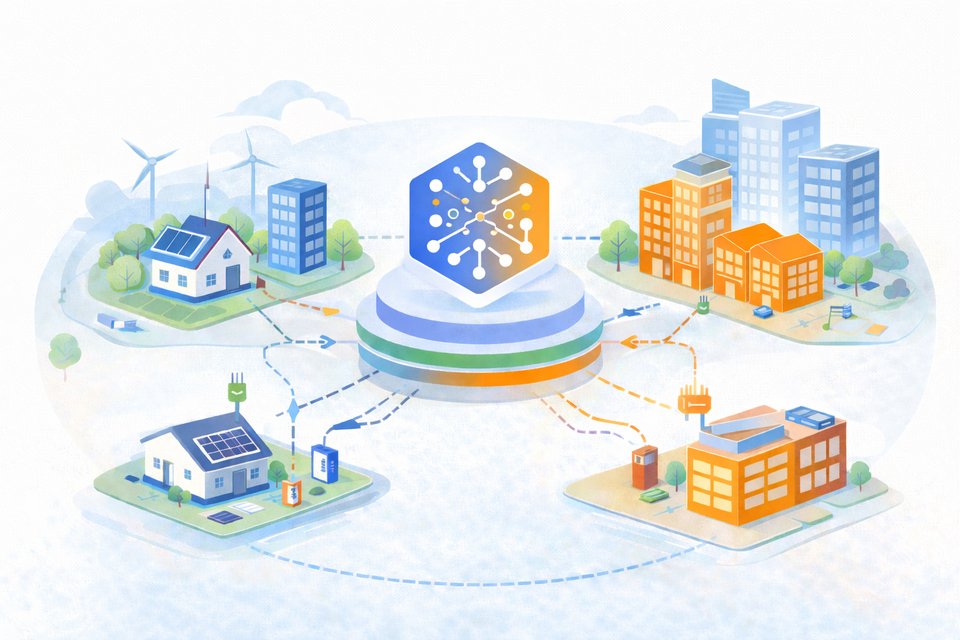
This doctoral dissertation aims to contribute to the agent-based dynamic simulation of an urban district's energy supply as a building block of an urban digital twin in the energy sector. SimStadt serves as the district-scale energy modelling tool and orchestration platform for this study.
The dissertation compares two integration paradigms for connecting SimStadt with heterogeneous consumers including EnergyPlus, AI-based agent models (e.g., EV charging) and 3DCityDB: FMU-based co-simulation and API/OGC-based web service architectures. Performance is evaluated across different scenarios using AI-assisted benchmarking. Where detailed physical modelling proves impractical, simplified AI agents are employed. This work is conducted within the EU FlexPED project.
Research questions
RQ1: What are the comparative advantages and limitations of FMU-based and API/OGC-based approaches for connecting SimStadt to downstream applications?
RQ2: How can AI-assisted benchmarking be applied to evaluate workflow performance across different simulation scenarios?
RQ3: To what extent can AI-based agent models (e.g., for EV charging behavior) replace or complement traditional physics-based models in district energy simulations?
RQ4: How do simulation scenario properties and choice of orchestration approach interact to affect scalability, robustness and interoperability?
RQ5: How does the orchestration approach (RQ1), AI-based agent models (RQ3) and scenario benchmarking (RQ2, RQ4) collectively enable the agent-based, dynamic district energy simulation workflows needed for urban digital twin applications?
Scientific approach and methods
The dissertation follows a comparative experimental design in which FMU-based and API/OGC-based orchestration strategies are evaluated under identical input data and scenario conditions. SimStadt provides district-scale modelling outputs and supplies the geometry, construction attributes and heat-demand results required by downstream tools.
Case Study 1:
EnergyPlus performs detailed building energy simulations, with results stored in 3DCityDB using CityGML and Energy ADE structures. In the FMU workflow, EnergyPlus is wrapped as an FMU and coordinated by an FMI co-simulation master. In the API workflow, SimStadt exposes REST/OGC endpoints with possible publish/subscribe communication for asynchronous data exchange.
Case Study 2:
AI-based agents are developed for components that are difficult to model physically, such as EV charging behavior derived from FlexPED datasets. These surrogates are integrated as FMUs in the FMU workflow and as API microservices within the API workflow.
Evaluation:
To enable automated, large-scale evaluation, a structured scenario space is explored using AI-assisted benchmarking. Both orchestration approaches are assessed across repeated scenario variations using quantitative metrics including scalability, robustness, interoperability, and latency. The results are synthesized into a generalized orchestration framework for dynamic and scalable district energy simulations.
Targeted results
1. A validated comparative framework that characterizes FMU- vs. API-based orchestration trade-offs using quantitative benchmarks
2. An extended SimStadt platform with a REST/OGC adapter and integrated AI surrogate capabilities
3. Evidence-based guidelines for selecting suitable orchestration strategies in urban digital twin applications

| Name & Position | E-Mail & Telephone | |
|---|---|---|
| Vice-President Research and Digitization | +49 711 8926 2663 | 1/121 |
| Researcher | +49 711 8926 2423 | 2/446 |
