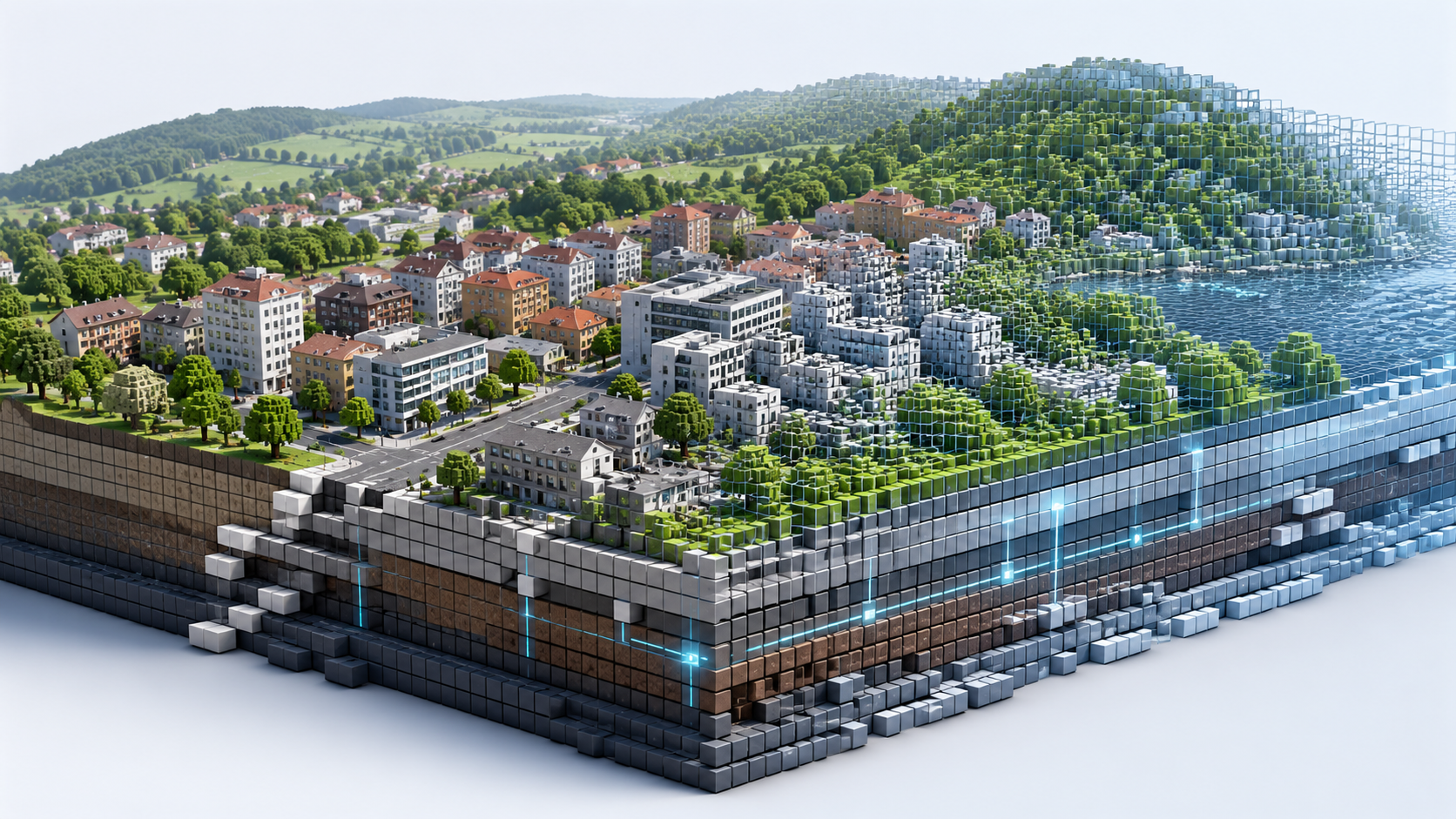
Through its “Internationale Spitzenforschung” programme, the Baden-Württemberg Stiftung specifically supports cooperation between research groups in Baden-Württemberg and internationally outstanding researchers. For Stuttgart Technical University of Applied Sciences (HFT Stuttgart), the funding approval for the research project VOXALYTICS is a particular success: HFT Stuttgart is the first university of applied sciences to be funded under this funding line.
VOXALYTICS stands for “An innovation approach for AI based urban analytics using large-scale voxel models and Urban Digital Twins”. The new research project VOXALYTICS, with a duration of 36 months, investigates AI-based urban analytics using voxel models and Urban Digital Twins. At the centre of the project is the question of how artificial intelligence can be made more usable for Urban Digital Twins, urban simulations and urban analytics. The project will be carried out at HFT Stuttgart under the leadership of Prof. Dr.-Ing. Volker Coors and Prof. Dr.-Ing. Zhihang Yao. The international partner is Prof. Sisi Zlatanova from the University of New South Wales in Australia.
Many cities and municipalities are already working with Urban Digital Twins. These are often based on 3D City Models. Such models are well suited to representing buildings and urban structures. For certain AI methods, however, they are only of limited suitability because their geometries are built from irregular polygon meshes and solids.
VOXALYTICS addresses this challenge: the project will develop and evaluate a regular voxel representation of a 3D City and Landscape model, including anthropogenic and geological structures. Voxels can be described, in simplified terms, as three-dimensional pixels. They divide space into small, regular cells and can therefore help prepare spatial data for deep learning methods and Large Language Models.
The approach will be investigated in case studies on urban climate simulation, urban fire propagation in above- and below-ground building structures, and pollutant dispersion from soil to surface. The required geospatial data will be provided by the City of Stuttgart.
With VOXALYTICS, HFT Stuttgart strengthens its research in 3D geodata, Urban Digital Twins, geoinformatics and artificial intelligence. The project combines HFT Stuttgart’s expertise in urban geoinformatics and 3D City Models with Prof. Sisi Zlatanova’s international research expertise in 3D modelling, data management and Urban Digital Twins.
In the long term, the results can help make existing 3D City Models more usable for AI-based urban analytics and simulations. Possible fields of application include climate-resilient cities, disaster response and, in perspective, the spatial orientation of mobile autonomous systems.
The funding approval for VOXALYTICS is an important success for applied research at HFT Stuttgart. It shows how the university brings together international cooperation, digital city models and AI-based analytical methods to contribute to current future challenges in urban development.
