Mathematics in your head, AI and algorithms in your code
The Master's degree programme in Applied Mathematics and Artificial Intelligence combines sound theory with pioneering technologies - welcome to the interface of mathematics and innovation.
"Master's in Applied Mathematics and AI - Where mathematical depth meets intelligent systems"
In this degree programme, you will learn to develop complex mathematical models and solutions and use them specifically to meet the challenges of digitalisation. Instead of just using AI as a tool, our students understand the underlying mechanisms and thus design intelligent systems that are efficient and secure.
This is what you can expect from the Applied Mathematics and AI degree programme:
In-depth specialist knowledge: Deepen your knowledge of applied mathematics, artificial intelligence and machine learning, as well as financial and actuarial mathematics or algorithm engineering.
Practical relevance: Apply theoretical concepts directly in projects, for example in the development of autonomous systems or the modelling of data and implementation of algorithms.
Excellent prospects: As an expert at the interface of mathematics and computer science, you will have a wide range of opportunities in industry, research and development - with above-average career prospects.
"Master's in Applied Mathematics and AI - Where mathematical models make real systems intelligent"
Use your mathematical talent to responsibly drive technological innovation!
Student Counselling Bachelor Applied Mathematics and AI / Master Mathematics
Get straightforward advice on your future degree programme! You will find the new dates for our digital student counselling service here shortly. Until then, please contact Prof Dr Stefan Reitz at stefan.reitz@hft-stuttgart.de +49 711 8926 2522 if you have any questions about the Master's in Mathematics.
The degree programme is offered both as a full-time course (standard period of study three semesters) and as a part-time course (standard period of study five semesters). The language of instruction is predominantly German.
"Data - Models - Markets: We make markets calculable"
Content from applied mathematics and artificial intelligence is taught on a scientific basis. Students have the opportunity to take at least four elective modules from the existing extensive range of compulsory electives. In particular, they can specialise in financial and actuarial mathematics or algorithm engineering.
"Developing algorithms. Understanding systems. Shaping the future."
The programme is supplemented by suitable content from computer science. In addition, topics from the diverse research activities of the HFT are taken into account and students' research skills are strengthened through research-based teaching formats in individual modules.
Master's programme "Master Praxis"
We also offer the "Master Praxis" programme. This includes an additional supervised practical study project (practical semester). This means that both the full-time and part-time versions of the programme comprise an additional semester. This programme is particularly ideal for students whose first degree is 180 CP.
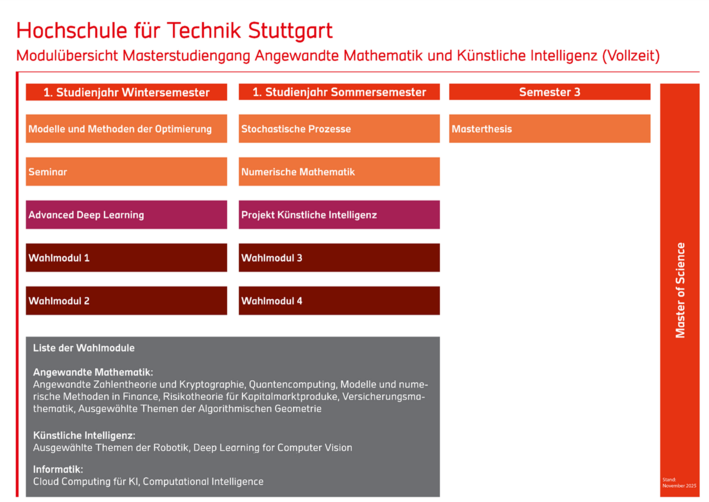
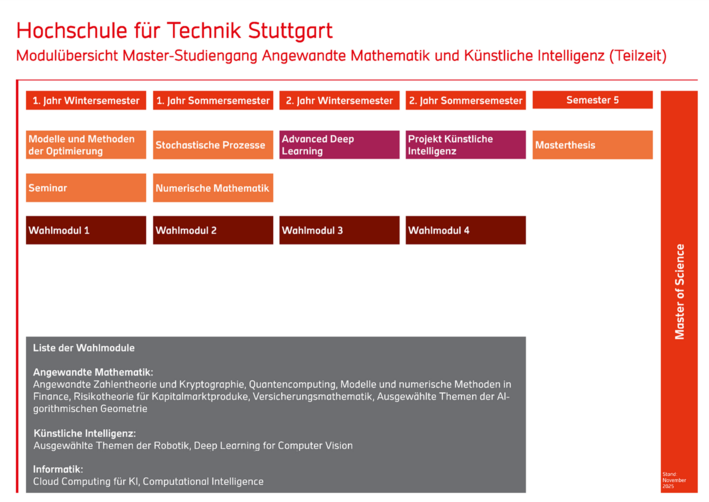
Documents on the future study and examination regulations (from WS 26/27)
(1) First university degree with a standard period of study of at least three years (180 credit points according to ECTS) in one of the following subject groups: Mathematics, Computer Science, Physics, Engineering with a strong mathematical focus
(2) First degree with an examination result of 2.7 or better
(3) Participation in an interview
(4) Proven knowledge and skills from the first degree in the fields of analysis, linear algebra, stochastics, numerics and computer science
(5) Qualified German and English language skills that qualify for university studies
Knowledge of artificial intelligence or machine learning is useful but not mandatory. Details on the admission requirements can be found in the admission and selection regulations.
Part 1: Tim Oliver Walter
Graduate of the Master's programme in Mathematics, part 2 see below
Right from the start, I liked the small groups of students in the lectures. This means you always have the opportunity to ask and get your questions answered immediately during the lecture. In some lectures, however, I would have liked to see a little more current topics, such as data science and artificial intelligence. However, the switch to a focus on artificial intelligence will already be implemented in the Bachelor's degree programme curriculum in the winter semester 2023/24.
The path to the Master's degree was often not easy for me and took a lot of strength, ambition and perseverance over the course of almost seven years of study. The Master's degree is particularly advantageous if, like me, you want to aspire to a managerial position later on.
This Master's degree programme is your springboard to management positions in business, research and development as well as access to the higher civil service. Graduates benefit from excellent career prospects in sectors such as finance and insurance, the tech industry or in the development departments of well-known industrial companies. Mathematicians are also in demand in consulting and the public sector. After graduation, you also have the option of pursuing a doctorate.
Part 2: Tim Oliver Walter
Graduate of the Master's programme in Mathematics, IT Consultant
When I left secondary school in 2009 and completed my training as a construction mechanic in 2012, I worked in the profession for two more years. I then attended a one-year vocational college in 2014 and obtained my entrance qualification for universities of applied sciences. I then enrolled on the Bachelor's degree programme in Mathematics at HFT Stuttgart in 2016 at the age of 21. After completing my bachelor's degree, I started the master's programme at HFT, which I have now successfully completed with an external master's thesis in the automotive industry.
When I completed my vocational training in 2012, I would never have thought that I would be able to call myself a Master of Science almost 10 years later.
Since April 2023, I have been working as a consultant in the fields of data science and AI at a management and IT consultancy. I got the job straight away because I had already been working in these areas during my degree programme for my final theses and practical semester as well as a working student. In addition, mathematicians are in high demand in the AI sector precisely because of the knowledge they gained during their studies (e.g. statistics).
The path to my Master's degree was often not easy for me and took a lot of strength, ambition and perseverance over almost 7 years of study. I would like to take this opportunity to thank Prof. Dr Stefan Reitz from the HFT's Mathematics degree programme, who supervised me on the last section of my Master's thesis. Without his really great support, this part of my studies would certainly have been a bit rockier
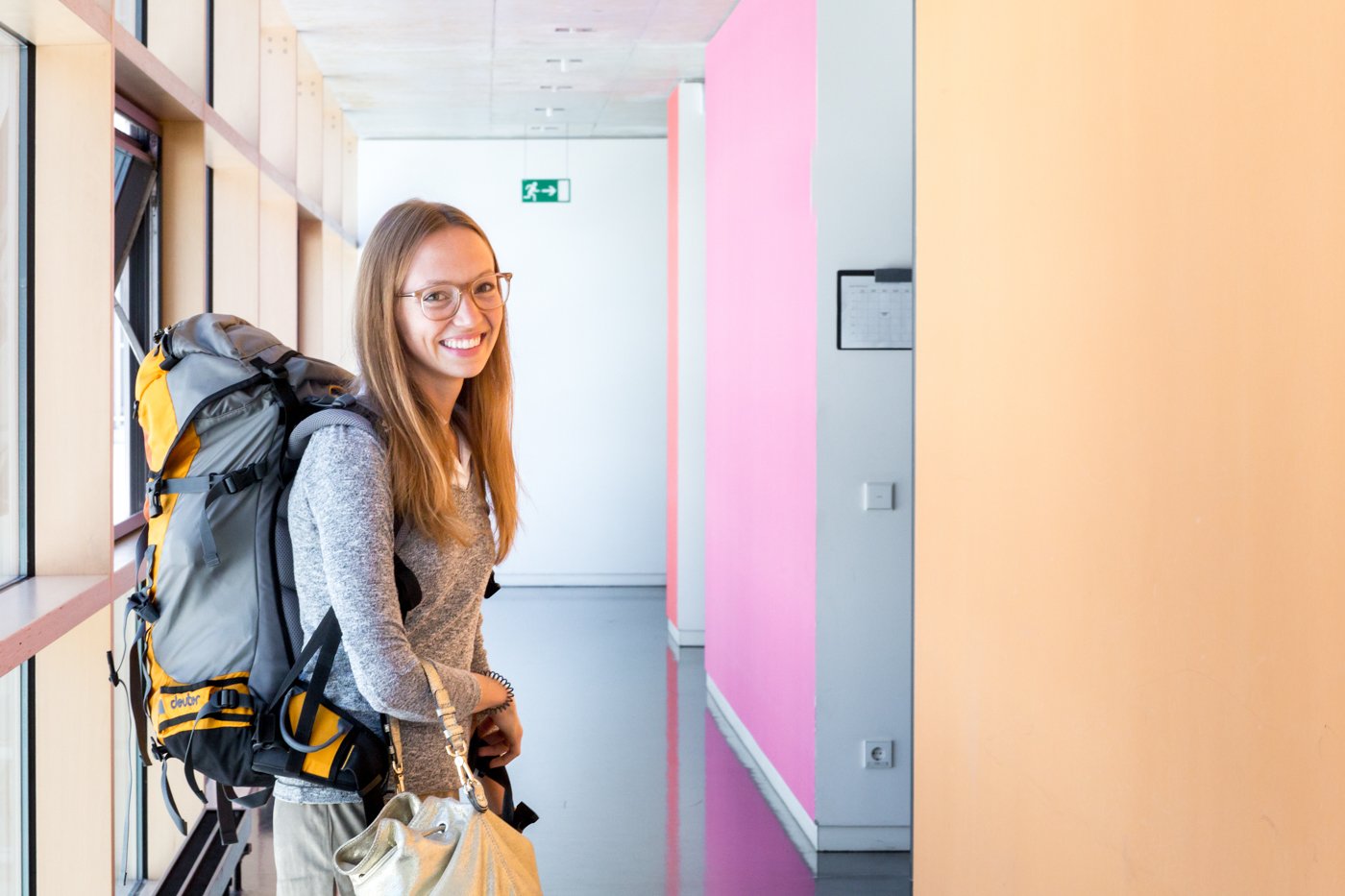
Semester abroad at the University of Split
Student reports on her experiences in Croatia
Martina Rahija spent the summer semester 2021 as an exchange student in Split. In her report she explains the requirements for the semester abroad and talks about her everyday life as a student of mathematics. Of course, she also talks about events and excursions organised by the Erasmus Student Network. She also talks about general topics such as accommodation, food and the weather in Split. This report with its practical tips is very helpful for future exchange students.
Students on the Master's degree programme in Mathematics have contacts with partner universities worldwide. The University's International Office will support you in preparing and planning a semester abroad.
If you have any questions, you can contact Prof Dr Anngret Weng at any time.
