The work
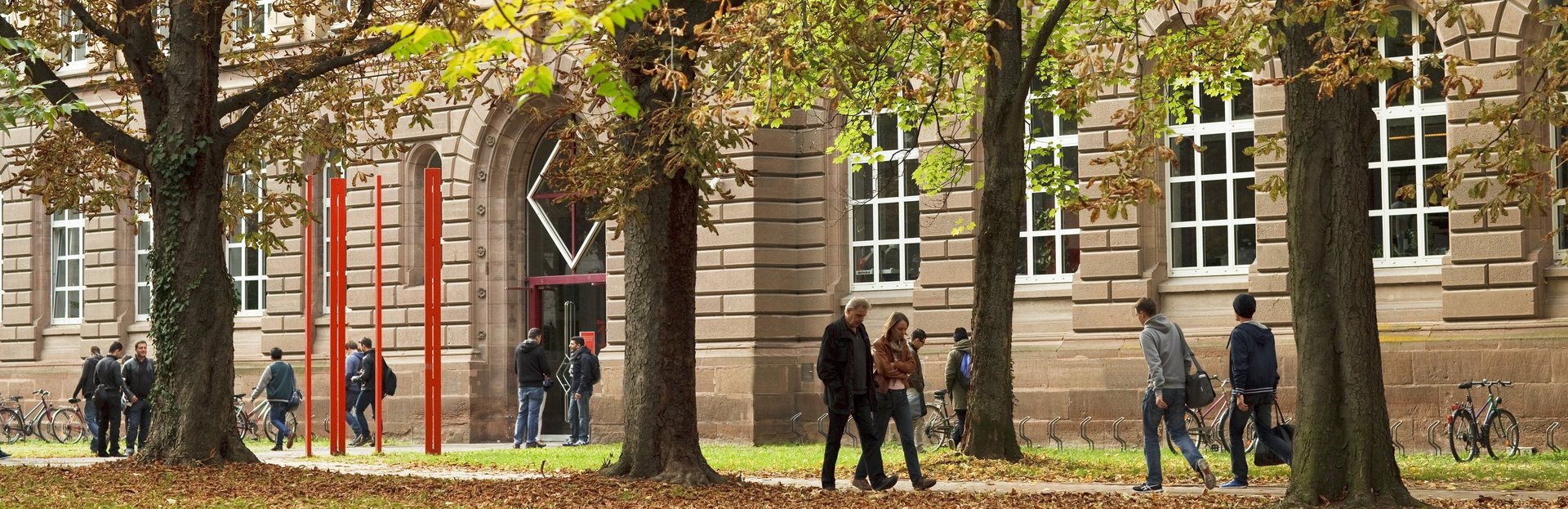
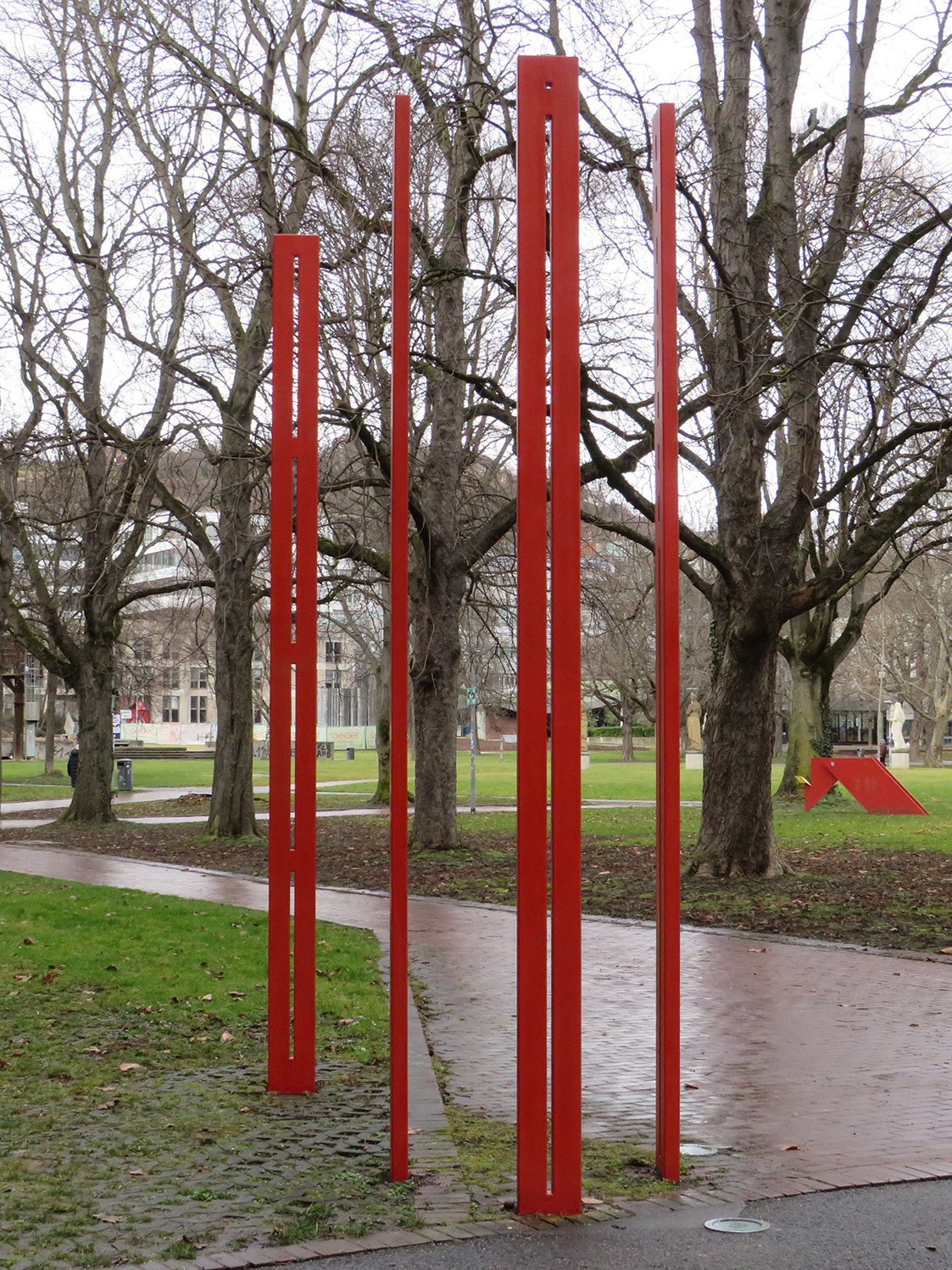
The multi-sided sculpture consists of four red, towering steel steles that appear to be loosely grouped in space. Two of the steles stand one meter apart with their broad sides facing each other. A third stele forms an isosceles triangle with these two at a distance of half a meter and is rotated 90 degrees in its orientation. The fourth stele is positioned opposite this one, but shifted axially by one meter. It also stands a good two meters away from the group of three.
The arrangement and “relationship” of the steles to each other change depending on the viewing location and the resulting different distances and angles of view. Sometimes only three of the steles are visible, sometimes the four appear lined up at equal distances, sometimes arranged in a semicircle, and sometimes as a group standing close together and facing each other.
Dr. Ute Schönfeld-Dörrfuß
Klaus Wagner's objects are characterized by a strict minimalist geometry, which, despite its abstraction, has an inherent personification. They are tall, straight bodies that extend into the space. They stand firmly and confidently in the landscape. The objects present themselves as waiting, observing, guarding, and attentive. [...]
Each stele consists of two rectangular hollow tubes that are cross-connected at least three times and anchored in the ground. The tubes measure six by ten centimeters in cross-section, are spaced two centimeters apart, and rise more than four meters high. The edges of the tubes are rounded at a slight angle, which makes the hard, heavy material more pleasant to the touch. The ambient temperature, to which the steel adapts and feels cold or warm depending on the circumstances, also changes this perception.
At a glance, all the steles look the same. However, by walking around them and looking closely, they reveal individual designs formed by varying numbers and thicknesses of cross-connections. The narrow spaces between the pipes create small “viewing openings,” long “openings,” or “incisions.”
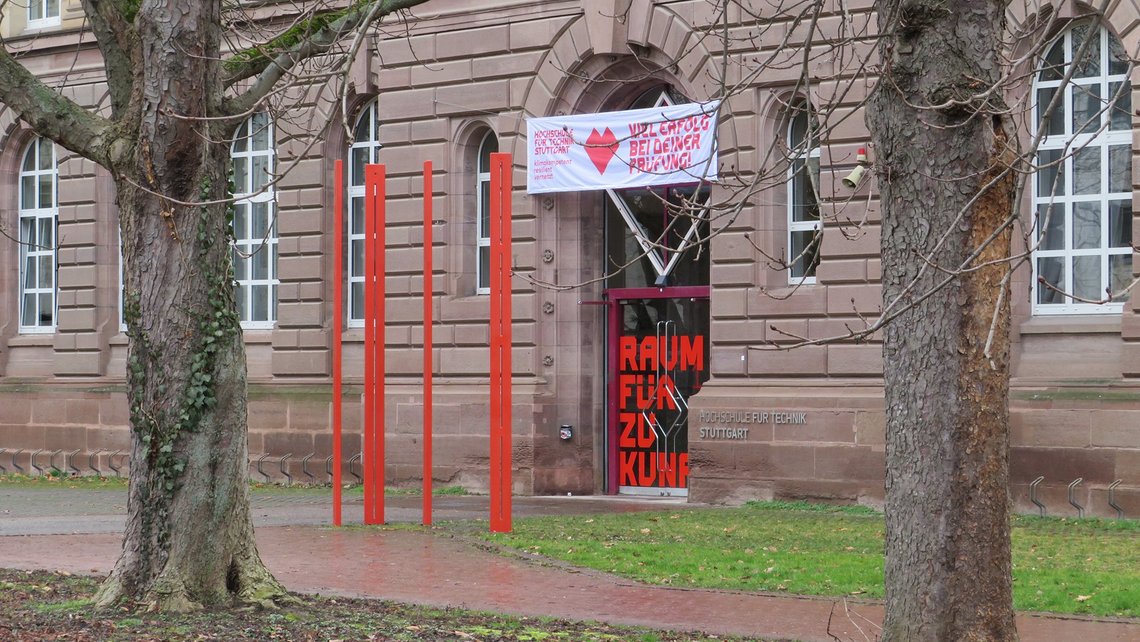
The stele at the approach to the entrance has one cross connection at the bottom and two at the top, revealing a small square peephole at the top. However, due to its height, no one can see through it. The stele facing the “Stadtgarten” has a total of ten bars, which divide the central space into one long opening near the ground and eight small openings in the upper area. This creates a uniform interplay of vistas and closed surfaces. The stele facing the main building is connected with two bars oriented toward the center and one at the bottom. Unlike the other three steles, this one is open at the top and the three incisions decrease in length from bottom to top. The space between the fourth stele is divided into four long vistas by five cross connections.
With its bold red coating, the work nevertheless stands out with its slender vertical lines in the heterogeneous environment of the “Stadtgarten”, which is overloaded with colors, shapes, and objects. The group of steles is visible from afar, pointing the way to the entrance and forming a kind of “welcoming committee.” The color red catches the eye and attracts attention. It is also associated with physical sensations such as blood, flesh, vitality, liveliness, and warmth. It therefore makes sense to interpret the two-part, towering steles as human figures. Figures that radiate strength, calm, and stability due to their materiality, design, and literal connection to the ground. – Striking but unassuming guardian figures that watch over the university and its members, show guests the way and welcome them.
The artist
Klaus Wagner (1956 Böblingen - 2005 Stuttgart)
A trained steelworker and social pedagogue, Klaus Wagner devoted himself to independent artistic work from the early 1970s onwards, favoring steel and iron as his materials and focusing on steel sculpture. He expanded his knowledge and skills as a guest student at the Academy of Fine Arts in Stuttgart.
From 1978 onwards, Klaus Wagner was a member of the Böblingen Art Association and participated in several exhibitions and projects in public spaces, such as “Aktion Bahnsteig 95” (1995) and “Köpfe am Korber Kopf” (2007/2008). This sculpture trail commemorated Klaus Wagner with the presentation of his steel and glass sculpture “Blauquadrat”, created in 1993, which is similar in form to the four steles at the HFT.
In the early 1980s, Klaus Wagner became an employee at the children's and youth workshop of what later became Werkstatthaus Stuttgart. There, he headed the sculpture workshop until his death.
The Donor
Walter Sorg (1930 Biberach - 2022 Stuttgart)
As a child, Walter Sorg learned how to work with wood in his grandfather's wagon-maker's workshop. Later, an apprenticeship as a bricklayer and carpenter and working in Max Fürst's office led him to a career as an architect. In addition to his uncle Max, two Stuttgart architects, Paul Stohrer (1909-1975), professor of design and interior design, and Hans Eitel (1906-1991), in whose office Sorg worked during his studies, were formative for his education.
While working in Stohrer's office, Sorg met Walter Pfaff, with whom he collaborated on buildings from the mid-1950s onwards. This partnership lasted until the founding of the architectural firm Sorg (now SFP Architekten GmbH) in 1962.
Sorg was a long-standing and active member of the association "Friends of the Stuttgart University of Applied Sciences," serving as secretary from 1993 and as chairman from 2000 to 2003. He was made an honorary member in 2006. With the donation of Klaus Wagner's work, Walter Sorg left a visible and lasting legacy.