Interactive Liminal Spaces | 1st Semester | Winter Semester 2025/26
Transforming narrative environments into spatial experiences
Teaching Team: Prof. Dr. Philipp Reinfeld, Mohammad Bidhendi (XR+LAB)
Liminal Spaces are spaces of in-betweenness — thresholds that resist clear classification. They exist between here and there, between past and future, between arrival and departure. Often they are transit spaces: empty train stations after midnight, endless hotel corridors, abandoned shopping malls, or gas stations in the middle of nowhere. They can exist in reality or appear only in imagination — in film, literature, or games. Their apparent lack of purpose gives them a unique tension: familiar yet strange, functionally designed yet full of undefined possibilities.
In psychology, liminal describes the phase between childhood and adulthood — a suspended state in which identity is still forming.
In recent years, Liminal Spaces have gained particular visibility in popular culture and digital subcultures. Memes like The Backrooms or viral image series of empty corridors and neon-lit rooms play with this aesthetic of the non-place. Film and gaming offer countless examples — from David Lynch’s Red Room in Twin Peaks to the endless hotel hallways in The Shining and the mysterious worlds of Silent Hill. Especially in digital environments, there is a growing fascination with in-between spaces, transit zones, and thresholds. They often hide behind the perfectly rendered surfaces of game environments, becoming accessible only through glitches or unintended movements. Terms like Out of Bounds or Backrooms describe these digital niches where the logic and mechanics of the world begin to break down or reverse. Such places are often deserted, strange, and uncanny. Architectural theorists, such as Marc Augé, refer to these as non-places — spaces without history or identity that become open to projection precisely because of their neutrality.
A CAVE (Cave Automatic Virtual Environment) is also a threshold space — a hybrid environment that is physically walkable and at the same time virtually boundless. Anyone who enters the CAVE finds themselves literally on the boundary between material architecture and three-dimensional projection. This makes the CAVE itself a liminal space in which real presence and virtual imagination merge.
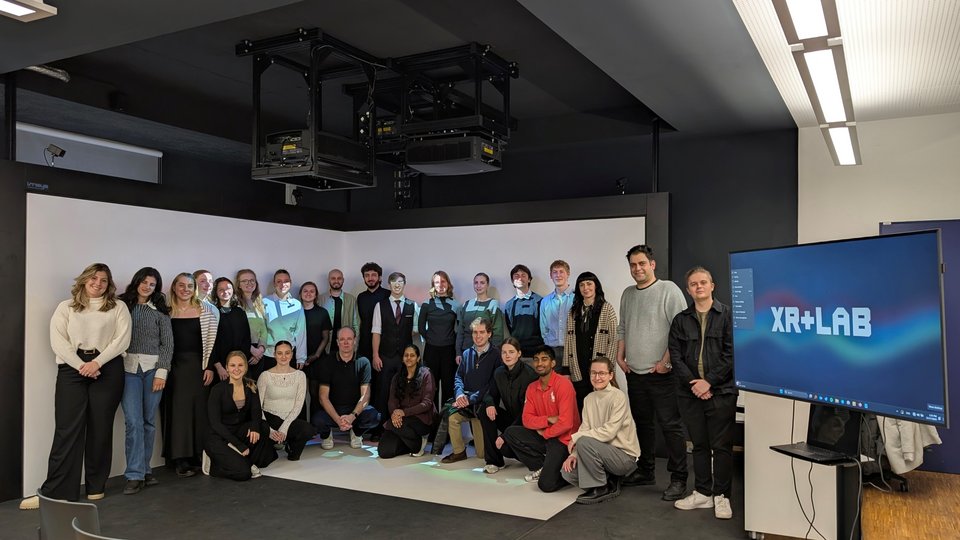
In this design studio, students researched, reconstructed, and transformed liminal spaces drawn from film, literature, gaming, or real architecture. Each space was digitally recreated in 3D, expanded and altered, and then experienced as an interactive scene inside the CAVE. The aim was to make the uncannily familiar nature of these transitional spaces tangible — creating a spatial narrative that draws visitors across the threshold of the image into an alternate reality, challenging their perception of space, time, and identity.