Overview
Climate change calls for collective action and will affect younger generations in particular. Yet for children and young people in particular, climate protection is often an abstract concept. That is why the Centre for Sustainable Urban Development, in collaboration with the local organisations KlimaTaskforce e.V. and the-NT.space e.V., is launching a citizen science project in Nürtingen to make climate protection tangible for children and young people.
Through a participatory approach, a climate monitoring station, sensor boxes, workshops and a visualisation concept are being developed and implemented to record the local microclimate. Through this hands-on experience as part of a ‘do-it-yourself’ and ‘do-it-together’ process, EnviMon raises awareness of climate protection, addresses the ‘climate anxiety’ felt by children and young people, and motivates them to engage with the issue of climate change.
Research questions
How can a local microclimate be made tangible and visible to children and young people through DIY sensor systems they have built themselves?
How does active, participatory involvement in the construction and measurement process change participants’ awareness of climate protection and their willingness to take action?
How can a participatory, local climate data network be established with children and young people and visualised publicly?
Scientific approach and methods
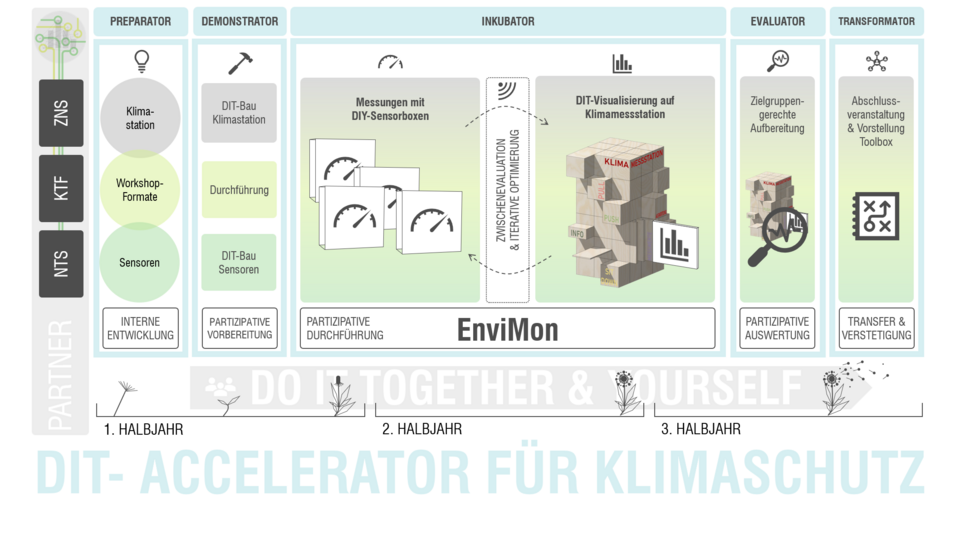
The research project will be implemented in five stages.
- In-house development: Design and preparation of the climate monitoring station, the workshop formats and the sensors.
- Participatory preparation: Construction of the climate monitoring station with children and young people.
- Participatory implementation: Construction of the DIY sensor boxes with children and young people in a DIT setting; Children and young people carry out DIY measurements in their local environment; the climate monitoring station is set up in a public space.
- Participatory evaluation: Research findings are evaluated and visualised together with children and young people.
- Transfer and sustainability: The climate monitoring station is installed at various locations, and the project results are presented to the public. A toolbox (building instructions for the climate monitoring station and DIY sensor boxes) enables the project to be replicated.
The selection and further development of measurement, data collection and evaluation methods are research-led and are not subject to any external methodological requirements. The choice of methods is iteratively adapted within the project and scientifically justified. To measure success, both qualitative objectives (including participants’ well-being and feedback on the workshop formats) and quantitative objectives (including project reach) are pursued. More than 50 per cent of the project’s resources are allocated to the collection, analysis and scientific evaluation of microclimate data.
Targeted results
The project is developing and testing a transferable participatory method (DIY/DIT) that enables children and young people to record the local microclimate themselves and make this information publicly available. The project is resulting in a local climate data network, a public climate monitoring station and an open-source toolbox to facilitate replication. The results contribute to citizen science and climate education and can be applied to similar urban contexts.


| Management | Prof. Dr. Christina Simon-Philipp |
| Partner | Klima-Taskforce e.V. (KTF), the-NT.space e.V. (NTS) |
| Funding | Klimaschutzstiftung Baden-Württemberg |
| Programme | Klimaschutz selber machen |
| Call for proposal | Do it yourself climate protection: do it yourself for sustainable ideas from the Baden-Württemberg Climate Protection Foundation |
| Duration | 01.04.2025–30.09.2026 |
| Name & Position | E-Mail & Telephone | |
|---|---|---|
| Professor | +49 711 8926 2616 | 8/3.51 |
| +49 711 8926 2365 | 4/304 |
