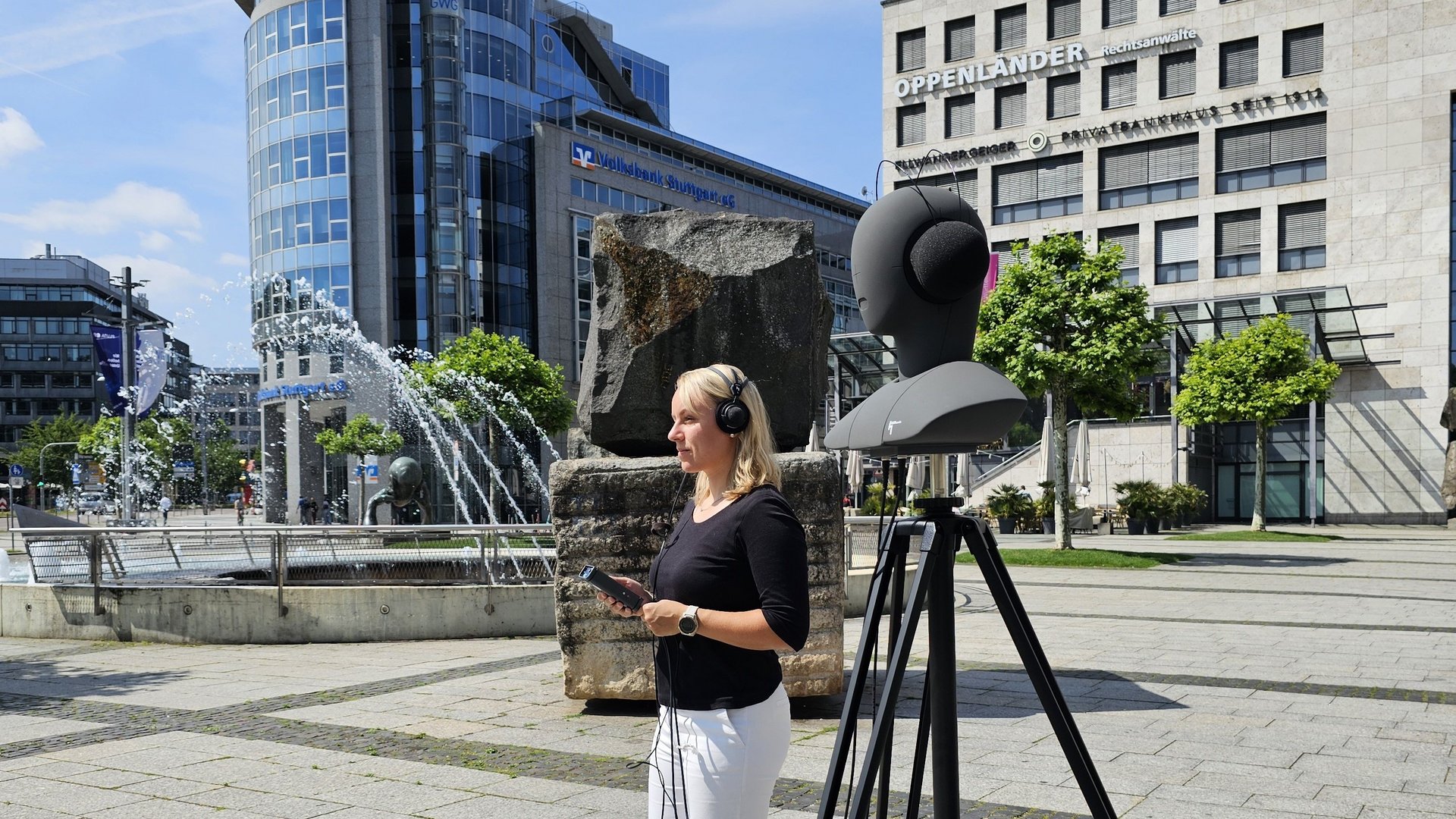
As part of her doctoral research, Michaela Marxt investigates how the perceived acoustic quality of open urban public places can be systematically measured, rated, and predicted. Since April of this year, the SONOCO project has been funded by the HEAD-Genuit-Stiftung. The project’s central web platform is now ready to launch.
“When public squares are acoustically unpleasant, people do not want to spend time there.”
This statement highlights the crucial role of acoustics in the planning of future, livable cities. Traditional noise control approaches fall short, as they tend to treat sound merely as an unwanted by-product of urban life. When acoustic environments are instead viewed together with human perception and contextual factors, as soundscapes, sound can be used deliberately as a resource in urban planning. This is especially relevant in densely populated areas, where public places are essential for nearby recreation.
Based on the soundscape approach, the project SONOCO explores how perceived acoustic quality in open urban public places can be assessed. By combining contextual information with acoustic data, the project develops predictive models that aim to forecast how people will perceive different environments. Data are collected through extensive on-site field studies, laboratory listening tests, and the new online platform. The project relies on professional acoustic measurement equipment, specialized software, and funding for field studies in different cities. Thanks to the support of the HEAD-Genuit-Foundation, all required resources for a successful implementation have been available since April. The doctoral research by Michaela Marxt is conducted within the doctoral program of the HIRE project and is supervised by Prof. Dr.-Ing. Berndt Zeitler and Prof. Dr. Thomas Bäumer.
The first milestone is the launch of the web platform MyCitySounds. It provides information about the project and ongoing updates. Under the title “Experience and Share the Sound of your City”, it invites users to rate public places themselves. This not only encourages people to engage more consciously with their urban surroundings but also provides valuable input for selecting future measurement locations. In parallel, online listening tests are being developed, allowing multiple soundscapes to be evaluated from home. The platform is now publicly accessible.
You can support the project directly by rating a public place at www.mycitysounds.de.